
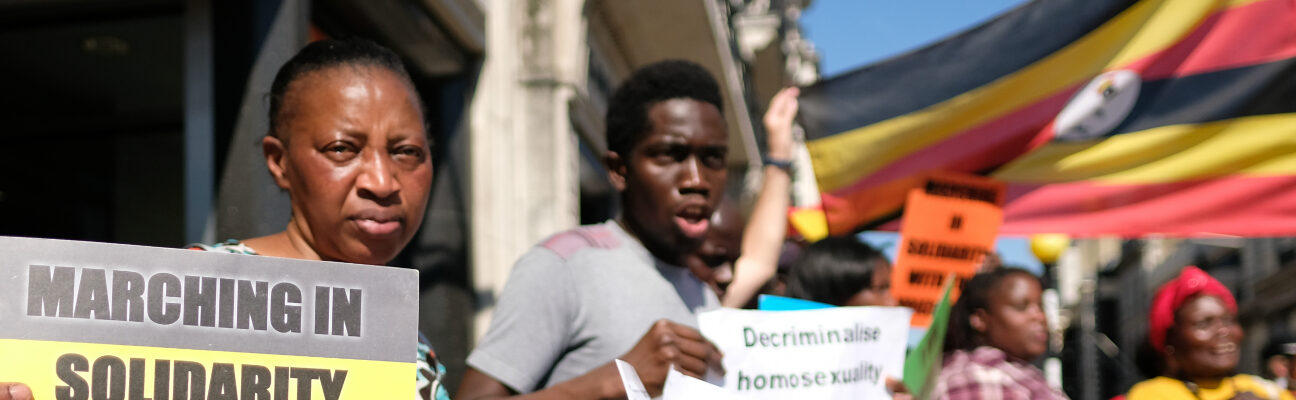
Uganda as a test ground for anti-rights legislation in Africa
When Uganda’s Anti-Homosexuality Act was enacted in 2023, it drew immediate international condemnation for its severity, including provisions for life imprisonment and, in certain cases, the death penalty for LGBTQ people.
Yet focusing only on global reactions risks missing a more consequential development. Uganda has emerged as a reference point for how restrictive, identity-based laws can be designed, tested and ultimately echoed across the region.
This trajectory did not begin overnight. As early as 2009, Uganda’s proposed Anti-Homosexuality Bill, widely known as the “Kill the Gays Bill”, captured global attention for its harshness. Although struck down in 2014 on procedural grounds, the ideas underpinning it never disappeared. Instead, they evolved, becoming more strategically framed and politically embedded, and maintained harsh clauses like the death penalty and life in prison. By the time the 2023 law was passed, it was no longer presented simply as a punitive measure, but as part of a broader narrative: the defence of cultural values and national sovereignty against perceived external pressure.
What is particularly striking is the pattern that has unfolded. Controversial legislation is introduced, international backlash follows, governments recalibrate their language or approach, and similar or more refined laws re-emerge. In this cycle, Uganda has effectively become a testing ground demonstrating the political gains of this approach and the associated (manageable) diplomatic costs, as well as civil society’s resilience to fight back
Uganda’s influence on other African countries
This model has not gone unnoticed. In Ghana, for instance, the Promotion of Proper Human Sexual Rights and Ghanaian Family Values Bill has followed a path that closely mirrors Uganda’s experience. After initial passage and subsequent legal challenges, it was reintroduced and passed again in 2026, retaining many of its restrictive elements.
Kenya, too, has seen proposals that echo Uganda’s punitive approach, signalling a growing regional willingness to legislate morality through criminal law.
Senegal’s recent move to increase penalties and criminalise advocacy further reinforces the sense that this is no longer an isolated trend but part of a wider legislative shift.
Join our Working Groups for members
A powerful narrative of foreign interference and national values
At the heart of this diffusion is a recognisable strategy. Political leaders mobilise public sentiment around the protection of cultural identity, frame dissent as foreign interference and position themselves as defenders of national values. In doing so, they tap into deeply rooted social conservatism while also consolidating political support. LGBTQ people, in this context, become more than a marginalised group. They are turned into symbols within a larger contest over sovereignty, identity and power.
The evolution of these strategies has now led to an even more significant development. Uganda’s Protection of Sovereignty Act, while not explicitly targeting LGBTQ people, has far-reaching implications for the broader human rights landscape. By restricting foreign funding to civil society organisations, the law strikes at the infrastructure that sustains advocacy, service provision and accountability. In many African contexts, civil society depends heavily on international support. Limiting these resources weakens not only rights-based organisations but also the essential services they provide to vulnerable populations.
This shift – from directly criminalising individuals to constraining the systems that support them – marks a more sophisticated phase in anti-rights governance. It allows governments to suppress dissent more quietly, avoiding the immediate global scrutiny that accompanies overtly discriminatory laws, while still achieving similar outcomes. The result is a shrinking civic space where fear and self-censorship become pervasive.
An African-wide anti-rights movement
Understanding Uganda’s role requires moving beyond the notion that these developments are purely domestic. The country now serves as a reference point within a broader ideological movement that is seeking to redefine the meaning and scope of human rights in Africa. This movement often frames itself as a rejection of “Western liberalism”. Yet it operates through transnational networks, shared narratives and policy borrowing which cross borders just as readily.
The human consequences of this legislative wave are profound. Beyond legal penalties, such laws contribute to climates of fear, where individuals face stigma, exclusion and, in some cases, violence. They legitimise discrimination in both public and private spheres, pushing already marginalised communities further into invisibility. At the same time, these policies have wider implications for diplomatic relations, development cooperation and economic engagement.
Resistance across the continent
Yet this is not a one-sided story. Across the continent, resistance continues to take shape in courtrooms and elsewhere. The battle against the Anti-Homosexuality Act is now at the supreme court of Uganda, and communities and advocacy spaces are evolving and designing new resistance strategies. Lawyers are challenging unconstitutional provisions, activists are documenting abuses and, despite mounting constraints, civil society organisations are working to maintain support networks and push for accountability.
These efforts highlight an essential reality: the debate over rights in Africa cannot be reduced to a simple opposition between “African values” and “foreign influence”. It is, instead, an ongoing and deeply contested negotiation over dignity, freedom and justice.
Uganda’s position at the centre of this moment gives it a particular significance. It can continue to serve as a proving ground for increasingly restrictive laws, or it can become a focal point for renewed efforts to strengthen rights-based governance. The direction it takes will depend not only on domestic dynamics, but also on regional interactions and the nature of international engagement.
Ultimately, the stakes extend far beyond any single country or community. What is unfolding is a broader question about the trajectory of human rights across Africa; whether legal systems will move toward greater inclusion and protection or toward deeper exclusion and control.
The answer will shape not only policy frameworks, but the lived realities of millions across the continent.
Related blogs
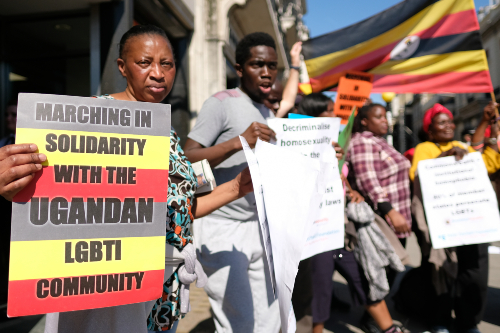
Uganda as a test ground for anti-rights legislation in Africa
Uganda’s Anti-Homosexuality Act has come to symbolise far more than a national legal shift, argues Edward Mutebi. It reflects a broader and increasingly coordinated movement shaping the future of human rights across Africa.

AI and humanitarian data: why safeguarding must come first
Maritz Cloete, Director of Risk Advisory, highlights the recent humanitarian data breaches which revealed the risks associated with poor data governance and the rapid adoption of AI. How can your organisation protect itself and others?
More than a number, less than a priority
At least one humanitarian worker is killed, injured, kidnapped or detained every day. As we mark World Humanitarian Day it is time for the UK government to take meaningful action.

Category
News & views