
Dual-generation programming in fragile contexts: what worked in Woliso, Ethiopia
When local or national instability interrupts schooling, investment in young children’s education can be lost.
In Woliso, Ethiopia, Children in Crossfire and local partner Maedot are responding with a dual-generation (2Gen) approach that supports children and their caregivers together. A new study shows what this has changed for families, and what it has not.
Woliso, in the South West Shoa zone of Ethiopia’s Oromia Region, absorbs the shocks of conflict in neighbouring areas. Displaced families arrive seeking refuge and local militia activity results in sporadic school closures, adding pressure to institutions and communities already stretched thin. For families, this means unstable livelihoods, limited access to essential services and psychosocial stress.
Hardship does not diminish parents’ aspirations. As one caregiver put it: “I have a few children that God gave me. I always think about what they need to live and survive.”
Many early childhood development programmes focus on either the child or the caregiver. Yet a young child’s development is shaped as much by the adult who feeds, comforts and plays with them at home as by the classroom. In fragile settings, where caregivers are managing financial pressure and stress of their own, the two are hard to separate.
How the programme works
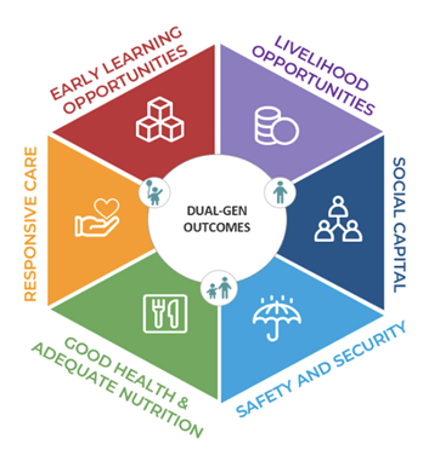
The Woliso programme treats children’s development and caregivers’ wellbeing as a single priority.
For children, the programme’s approach to school transformation makes classrooms more conducive to play-based learning and links children to health services to support their health and nutrition. For caregivers, the programme combines parenting and responsive caregiving support, health and nutrition education, trauma-informed messaging, and livelihood support through village savings and loan associations (VSLAs).
Parenting sessions are delivered through traditional coffee ceremonies. These are familiar, regular spaces where caregivers of young children meet, share experiences and build relationships.
The programme’s components reinforce one another. Savings make it easier to meet children’s needs, peer networks ease stress, and knowledge and confidence lead to more responsive care.
Between 2025 and 2026, the research organisation Busara carried out an exploratory mixed-methods study comparing caregivers in the programme with a comparable group of caregivers from surrounding areas who did not take part. Four findings stand out.
1. Caregivers turned knowledge into practice
Caregiver wellbeing was low across the whole sample, scoring around 8 out of 25 on a wellbeing measure. Even so, caregivers in the programme reported significantly better wellbeing than the comparison group, along with stronger parent-child interactions, greater confidence in recognising trauma, and more positive and responsive parenting.
Both groups could describe what good parenting and nutrition look like. The difference lay in daily practice. Caregivers in the programme:
- were twice as likely to report seeking immediate medical attention when a child was ill
- were more likely to soothe a distressed child straight away, or to find out why they were crying
- were more likely to play with their children, and showed significantly stronger knowledge of play-based learning
- scored substantially higher on nutrition knowledge, feeding attitudes and nutrition practice.
Caregivers put these changes down to training and the confidence it gave them, not to greater material security. One caregiver observed: “The change came after I received training… I have gained a lot of information about child development.”
2. Savings groups built resilience, even where income did not rise
Families in both groups remained economically insecure. Most earned less than 3,000 Ethiopian birr a month (around £13.70) and went without income for an average of 3.3 months each year. Income levels did not differ significantly between the groups. What differed was the ability to cope.
Caregivers in the programme reported more diverse livelihoods and a stronger ability to manage financial shocks, largely through their VSLAs. For families living with persistent poverty, that resilience can matter as much as income itself.
The mother of a child called Galani, who was in a savings group started by Maedot, said: “With that loan, we do small trading and improve our lives little by little.”
3. Trust grew through meeting regularly
Both groups described living in close-knit communities. But being surrounded by people is not the same as having people to rely on. Caregivers in the programme reported substantially higher levels of community trust, which the study links to the repeated collective practice of coffee ceremonies and VSLAs. As one association member explained: “We, the mothers, together attend trainings, go to meetings… we support each other, we stand by each other, we organise coffee ceremonies for each other, we host each other, we connect with the community.”
4. Longer participation brought stronger results
Caregivers who had been in the programme longer reported stronger wellbeing, more positive and responsive parenting and greater use of play-based learning. Over time, the qualitative evidence suggests, these behaviours became part of everyday routines. When money was tight, families adapted the practices instead of abandoning them.
What this means for programmes in fragile contexts
The programme did not overcome the structural challenges families face. Income remained low, healthcare remained constrained by cost and distance and caregiver wellbeing remained fragile. But the findings offer three lessons for others working in similar settings:
- Support children and caregivers together. Families do not experience these challenges separately, and support is most meaningful when it reflects that reality.
- Do not wait for circumstances to improve. Caregivers built greater capacity to support themselves and their children while still living with significant hardship.
- Build on trusted, recurring spaces. Change was sustained through repeated practice with peers, in coffee ceremonies and savings groups, and not through knowledge alone.
Children and caregivers live their lives together, a simple truth that2Gen programming recognises. In fragile contexts, where families navigate several pressures at once, this offers a promising place to start providing more effective support.
Related blogs
Dual-generation programming in fragile contexts: what worked in Woliso, Ethiopia
What difference can supporting children and caregivers together make for families living in fragile contexts? Matthew Banks explores a dual-generation programme in Woliso, Ethiopia, and what new research reveals about its impact on parenting, wellbeing, financial resilience and community trust.
Justice that Heals: a new model to help address the global issue of child sexual abuse
Over 370 million girls and women globally have been subjected to rape or sexual violence as children and many experience devastating, lifelong consequences. Kids Alive International has established a new model to address this global problem.
What genuine youth partnership looks like
Four young advocates reflect on the idea of radical accountability and a 10-point plan that could usher in an era of genuine youth-adult partnership.

Category
News & views