

The humanitarian system doesn’t need to “empower” local communities. It needs to enable them.
The past few years have tested the resilience of the humanitarian sector to its core.
The sector has experienced a collision of myriad forces that are pushing, pulling and stretching it in ways it has never experienced before.
Just as humanitarian needs have substantially increased, funding has significantly decreased, further widening the financial gap in an already overstretched system. The donor landscape has also changed dramatically. In 2025, 18 of the 20 largest aid-recipient countries experienced funding cuts, according to ALNAP’s Global Humanitarian Assistance report.
But financial constraints are only part of the challenge. The way humanitarian aid is delivered has also been critically affected. We are seeing a retreat towards more centralised, less collaborative and more competitive ways of working, often resulting in inefficient and reactionary responses.
These trends present a significant barrier to one of the sector’s long-standing ambitions: localisation.
From empowering to enabling
For years, the humanitarian sector has moved from one buzzword to another. One that has remained prominent in humanitarian and development discourse is “empowerment”.
But perhaps it is time to look more closely at what we mean by it.
The concept of empowerment can imply a top-down relationship, in which one actor holds power and grants it to another. While this is no condemnation of the term itself, the language we use matters. It shapes how we understand relationships, communicates assumptions about who holds expertise, and can ultimately influence how resources and decision-making power are distributed.
Perhaps we should think less about empowering communities and more about enabling them to exercise the power, knowledge and capabilities they already possess.
This is not simply a question of language. It requires a fundamental shift in how the international humanitarian system understands its role.
Local actors are the pillar of the humanitarian system
Localised, small- to medium-scale crises accounted for 68% of all economic losses between 2005 and 2017, according to the United Nations Office for Disaster Risk Reduction. Thousands of crises around the world receive little to no political or media attention internationally, yet local actors and communities are continuously responding to their devastating impacts. They are often the first to respond and the last to leave.
Despite this, the “formal” humanitarian ecosystem can still reduce local actors to the roles of “beneficiaries” or “sub-contractors”. This reinforces a paternalistic system that continues to hold power and resources away from the communities closest to crises.
The result is a system that can inadvertently undermine the very resilience it seeks to strengthen, perpetuating international dependency rather than building sustainable local capacity.
Paternalism is not the solution
For decades, organisations around the world have advocated for a shift in how international and humanitarian aid is delivered.
In Latin America, asistencialismo – a difficult word to translate into English, but roughly meaning “paternalistic assistance” – is a normalised practice within parts of the development and humanitarian sector.
Alejandra Atz, from ASECSA, a Guatemalan association of aid organisations, describes some of the challenges faced by local organisations in Guatemala:
The main issue is to respond to the urgent needs of communities without creating a dependency on immediate aid.
Achieving this, she explains, requires striking “a balance between providing vulnerable groups with what is essential to cope with the emergency and, at the same time, promoting their participation in long-term capacity-building processes where they collectively develop solutions from within their own communities that strengthen community resilience”.
This distinction is crucial.
Humanitarian assistance is necessary, particularly when people are facing acute crises. But assistance should not come at the expense of agency. The objective should be to support communities in building and sustaining solutions themselves, drawing on their knowledge, relationships and understanding of the context in which they live.
That means moving from a model of providing for communities to enabling communities to lead.
What locally-led humanitarian action can look like
In recent years, much attention has rightly been given to humanitarian reform and localisation. Progress has been made in including local organisations in international forums, and these conversations are both important and necessary.
But policy commitments alone will not transform the system.
Alongside these discussions, more pragmatic, action-oriented initiatives are already demonstrating what locally-led humanitarian action can look like in practice.
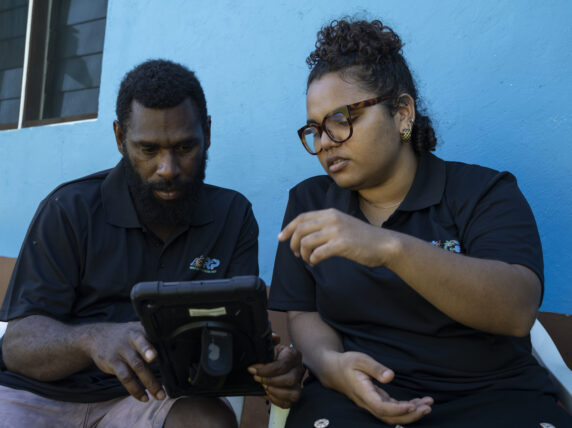
One such effort is the Community-Led Innovation Programme, a six-year global humanitarian programme that placed crisis-affected communities at the centre of decision making.
Community innovators developed solutions to address local humanitarian and climate challenges, resulting in 17 locally-led solutions across Guatemala, Indonesia, the Philippines and South Sudan.
The approach did more than produce individual solutions. It helped strengthen capabilities within communities, with changes observed in mindsets and problem-solving skills.
Although the programme has now concluded, its innovators have established themselves as key players within their communities – capable of identifying challenges, designing solutions and collaborating effectively with local decision-makers to anticipate disasters and reduce their impact.
The programme demonstrates what becomes possible when communities are not simply consulted or included, but trusted to lead.
Moving local actors from the periphery to the centre
The humanitarian sector is operating in an environment of growing need, shrinking resources and increasingly complex crises. Continuing to work in the same ways while expecting different results is not a viable long-term strategy.
The belief that “this is simply how the system works”, or that reforming it is too great a burden, risks condemning us to repeat past mistakes. These mistakes have cost lives and livelihoods, prolonged dependency and wasted valuable resources.
Local actors have already demonstrated that they have the knowledge, relationships and capabilities required to lead effective humanitarian responses.
The question is no longer whether local actors have the capacity to lead.
The question is whether the international humanitarian system is willing to let them.
That means moving beyond the language of empowerment towards genuine enabling: sharing decision-making power, shifting resources, recognising local expertise and creating the conditions in which communities can develop and sustain their own solutions.
In a humanitarian system facing unprecedented pressure, localisation should not be treated as an optional reform or a long-term aspiration.
It should be recognised for what it is: one of the most important ways of making humanitarian action more effective, sustainable and accountable to the people it exists to serve.
Related content

Organisational capacity strengthening: why generic training is not enough
Liubov Rainchuk explains how World Jewish Relief has shifted from being a “donor-monitor” to a “partner accelerator” by taking a new approach to capacity strengthening. What are the four levels of partner needs?

Ecology and empowerment
How is ecology and empowerment linked when it comes to international solidarity? Contributors from seven countries have attempted to provide some answers to this question in a new book coordinated by the F3E network. Isabelle Moreau shares the key findings.
AI could be a lever for localisation – but genuine partnership and investment is needed
From a year of dialogue with humanitarian practitioners across the ecosystem, the message is clear: AI could be a genuine lever for localisation – but only if there is renewed thinking, partnership and intentional investment, Ka Man Parkinson at Humanitarian Leadership Academy argues.

Category
News & views