

How Oxfam put trust-based flexible funding into practice
Local organisations are best placed to lead change, yet funding models often limit their ability to do so.
Further findings on why trust-based, flexible funding delivers more effective partnerships and how trust‑based, flexible funding is changing Oxfam’s partnerships are available.

Why local leadership matters for lasting change
Oxfam has long recognised that meaningful change happens when local organisations and movements lead the shaping of responses, setting priorities, and driving solutions in their own communities. Working in partnership with and in support of partner-led initiatives has always been central to Oxfam’s ambition.
But, there has been a gap between ambition and reality.
Where do current funding models fall short?
Like many international NGOs (INGOs), Oxfam’s own systems – and those of its donors – have often made it difficult to fully support local actors. Some organisations, such as informal movements, struggle to access funding at all. Others find their ambitions constrained, particularly when it comes to investing in their own organisational development, visibility, or long-term sustainability.
Recognising this, Oxfam GB developed a Decolonial Partnership Strategy.
A key question followed: what would it take to put this into practice? One answer was clear – Oxfam needed to fundamentally rethink how it funds and supports partners.
Why Oxfam explored flexible, trust‑based funding
Oxfam’s experiment with flexible funding was driven by a simple but ambitious idea: if partners had greater freedom, and if relationships were built on trust rather than compliance and control, would this enable deeper, more meaningful change?
The working theory was that flexible, multi-year funding – combined with reduced reporting and compliance requirements – could create space for partners to pursue their own strategies, rather than those shaped by donor priorities.
This approach was also seen as a practical way to advance Oxfam’s decolonial ambitions. Shifting power requires tangible changes in how decisions are made and who controls resources.
Trust-based, flexible funding offered a way to test this in practice.
What Oxfam wanted to learn
While some donors and organisations already fund flexibly and do it well, the questions for Oxfam, as an INGO, were:
- What does flexible funding look like when implemented by an INGO?
- What challenges would arise within Oxfam’s own systems and culture?
- What would partners value most about this approach?
- And crucially, how might it change relationships?
Underlying all of this was a broader hypothesis: there are better ways for INGOs to partner – and Oxfam needed to find them.
Putting trust at the centre of funding relationships
Flexible funding is not just a technical shift – it is a relational one. It requires trust.
What did this mean for Oxfam?
This meant trusting partners to make the right decisions for their organisations and communities, without constant oversight or control.
What did this mean for partners?
This meant trusting that Oxfam’s commitment to shifting power was genuine – that greater autonomy would not later be undermined by increased scrutiny or risk aversion.
This mutual trust could not be assumed; it had to be built. And building it required both sides to question long-standing assumptions about accountability, expertise, and control.
Creating space to experiment: the Partners’ Investment Fund
Oxfam’s Partners’ Investment Fund (PIF) was designed as a deliberately experimental space. It aimed to challenge and disrupt established ways of working – both in how funding is delivered and how partnerships are structured.
More than just a funding mechanism, the PIF was conceived as a joint venture. Country teams and partners were encouraged to treat it as a shared space for learning, where they could:
- reflect openly
- challenge each other constructively
- solve problems together.
This meant taking risks together. It meant adapting as the experiment unfolded. And importantly, it meant committing to learning – not as an abstract goal, but as something to be actively applied to improve future practice.
How the Partners’ Investment Fund worked in practice
What made the Partners’ Investment Fund different?
The PIF combined several features that, together, marked a significant departure from traditional funding models:
- Multi-year, flexible funding that partners could allocate according to their own priorities.
- Minimal reporting requirements, relying on existing statutory reporting rather than bespoke donor formats.
- Tailored due diligence, replacing one-size-fits-all approaches.
- A focus on relationships and learning, rather than compliance.
In addition to a radically different approach to funding the PIF also modelled new principles, behaviours and commitments.
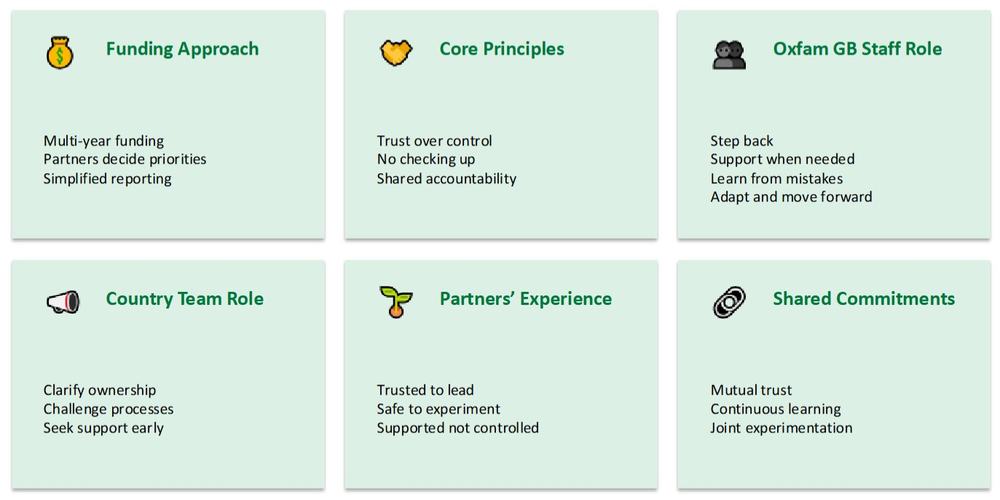
Trust based flexible funding model
These changes were designed to shift both power and practice – creating space for partners to lead, and for Oxfam to rethink its role.
Why flexible funding was not easy in practice
Contrary to some people’s expectations, the PIF was not easy to implement. In fact, it often proved surprisingly difficult.
Without the usual “guardrails” of tightly defined budgets, logframes, and reporting templates, both Oxfam staff and partners had to navigate unfamiliar territory. Established ways of working no longer applied, and new ones had to be jointly envisaged and implemented.
Questions that challenged long‑held assumptions
This raised the following questions:
- Was this really the partners’ money?
- How flexible was “flexible” in practice?
- If there were no reporting templates, what should partners share – and how?
- If Oxfam was no longer checking, directing, or approving, what was its role?
These were not just technical questions – they went to the heart of deeply embedded beliefs about accountability, expertise, and control.
Unlearning old ways of working
Implementing the PIF required a significant process of unlearning – and it was a challenge.
For both Oxfam and its partners, years – often decades – of ingrained practices had to be questioned. Habits shaped by compliance-driven systems cannot disappear overnight.
Unlearning is like walking backwards. It is a wobbly, difficult experience, for Oxfam and its partners. It is disorientating and often slow. It requires individuals and teams to step into new roles without clear templates, and to operate with greater vulnerability.
Yet this process was essential. If the goal was to shift power closer to where change happens, then existing assumptions and behaviours had to be challenged.
What Oxfam learned about becoming a better partner
At its core, the PIF experiment was about transformation – for Oxfam and partners alike.
A key question was not only how flexible funding benefits partners, but what Oxfam needs to change in order to become a better partner.
This includes reflecting on internal systems, decision-making processes, and organisational culture. It also means rethinking roles – moving from being a controller or gatekeeper to being a supporter, facilitator, and ally.
Through the PIF, Oxfam and its partners began to explore what more equitable, effective partnerships could look like – and what it would take to make them a reality.
Learning from others working with trust-based funding
Oxfam did not start from scratch. The PIF builds on the work of organisations and initiatives that have long championed flexible, trust-based funding.
For example, Oxfam’s Women’s Rights Fund has demonstrated how multi-year, flexible funding – combined with tailored support – strengthens organisations and movements over time.
By learning from such models and adapting them within an INGO context, Oxfam hopes not only to improve its own practice but also to contribute to wider change across the sector.
What next for trust-based funding at Oxfam?
The next challenge is to take what has been learned and apply it more broadly: within Oxfam, with donors, and across the wider development sector.
Ultimately, this experiment was about more than funding. It was about challenging long-held assumptions and practices, rethinking relationships, redistributing power, and enabling those closest to the issues to lead change.
This blog was first published by Oxfam.
Related content
What will it take to make localisation a reality? Part two
Alexandra Newlands of the Scaling Up Nutrition Civil Society Network follows up on her previous blog about stalled localisation, asking whether decision-making and funding are actually moving closer to where impact happens.

Re-imagining the future of the INGO
Mary Ann Clements, co-lead of ADD, reflects on the changes the organisation has made so that funding can flow more freely and directly to disability justice movements in other countries.

Your website as a governance asset: managing risk during change and scrutiny
Why it’s time to stop thinking about your organisation’s website solely as a communications tool. Eric Phung unpacks the common ways NGO websites undermine organisational credibility and explains why treating your website as core infrastructure can help build trust and resilience.

Category
News & viewsThemes
Funding