

Building a funding pipeline that reflects your strategy
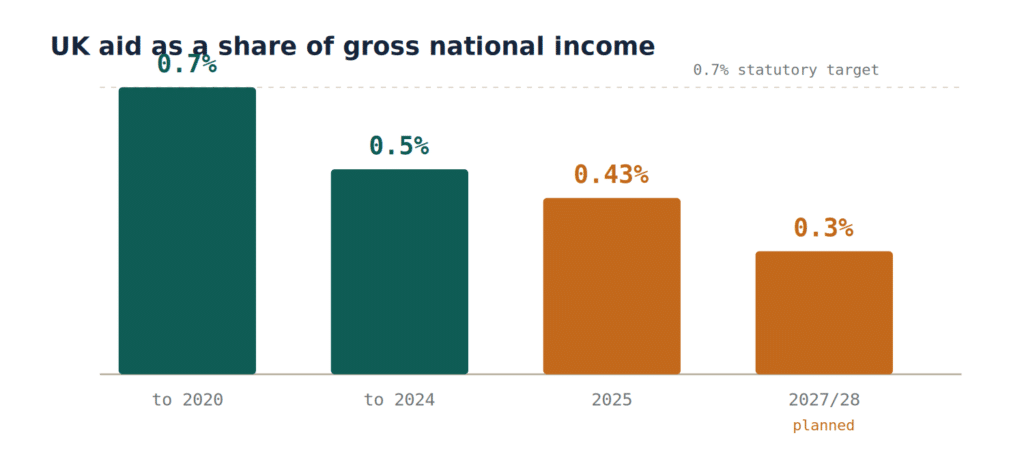
In April 2026, Bond reported that UK aid had fallen by more than £1 billion in a single year, to 0.43% of gross national income, and the steepest cuts are still ahead.
By 2027/28 the budget will reach 0.3%. This is around £6 billion a year less than it would have been at 0.5%, and the lowest level as a share of national income since 1999. For organisations that built their plans around institutional money, the ground is moving.
The instinct in a shrinking market is to apply for everything. That instinct is the problem.
The cost of chasing everything is rarely counted, but it is large. UK charities already spend an estimated £900 million a year applying for grant funding, much of it on bids with little chance of success.
On some competitive UK grant programmes, fewer than one in five applications succeed. One sector report described a charity completing a 60-page application for a £500 grant. Every speculative bid consumes the time of your most capable people, the same people who could be deepening the relationships that actually convert.
| The economics of chasing everything | Source |
|---|---|
| £900m spent each year by UK charities applying for grant funding | Action Planning |
| Under 1 in 5 applications succeed on some competitive UK grant programmes | Plinth |
| £500: the value of one grant a charity pursued with a 60-page application form | Sector report |
The real danger is not waste. It is dependence.
Wasted effort is expensive, but it is survivable. Dependence is not. Research from the University of Birmingham found that over half of UK charities receive at least 90% of their income from a single source. When that source moves, the organisation moves with it, whether it wants to or not.
Last year showed what that looks like at scale. When USAID closed in July 2025, it took with it 83% of US assistance programmes and more than 5,300 projects. By April 2025, before the closure was even complete, 81 INGOs had already shut at least one office. Organisations that had allowed a single funder to become their strategy discovered they had no strategy of their own.
So how do you build a pipeline that reflects your strategy rather than chasing it? By following three disciplines, each of which costs nothing but candour.
1: Define what a strategic opportunity is
A strategic opportunity advances your strategy, not merely your budget. That distinction sounds obvious but it is routinely ignored. A grant that funds work you would not otherwise do is not income. It is a detour with a cheque attached.
Before any opportunity enters the pipeline, it should pass a single test: if we win this, does it move us closer to what we already decided matters? If the honest answer is no, it does not belong, however large the sum. Naming that test, and applying it aloud in every pipeline meeting, removes more clutter than any process ever will.
2: Prioritise high-value opportunities
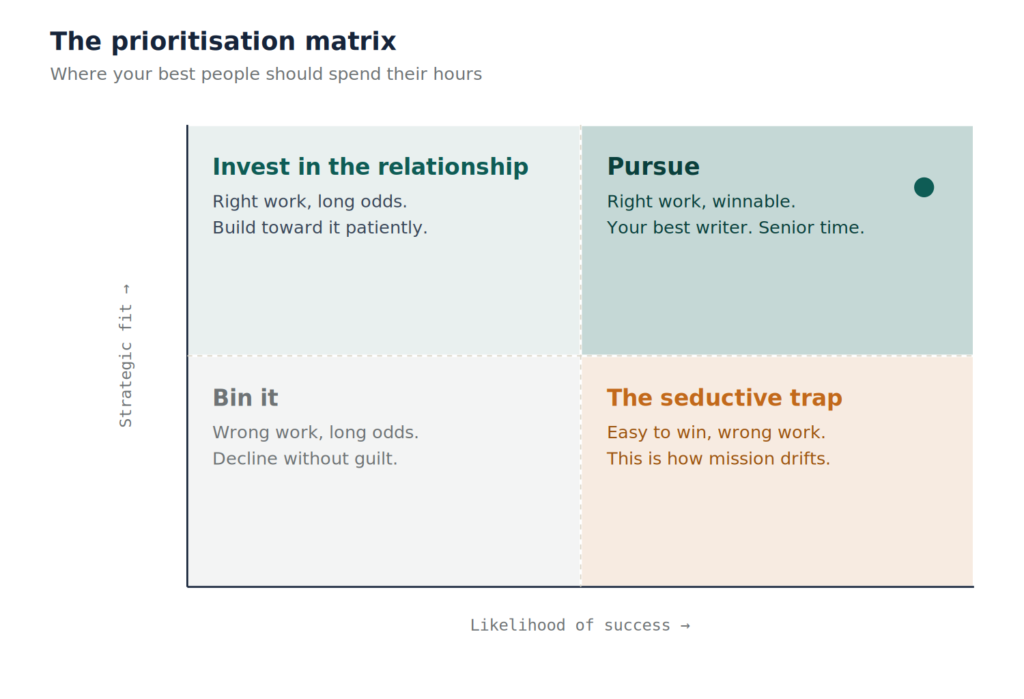
Most teams sort their pipeline by deadline, which means the loudest opportunity wins attention regardless of whether it is worth winning. A better method ranks each opportunity on two axes: how well it fits your strategy, and how likely you are to secure it. With fewer than one in five applications succeeding on competitive funds, spending your best hours on poor-fit bids is the most efficient way to exhaust a team while standing still.
3: Review and refine the pipeline regularly
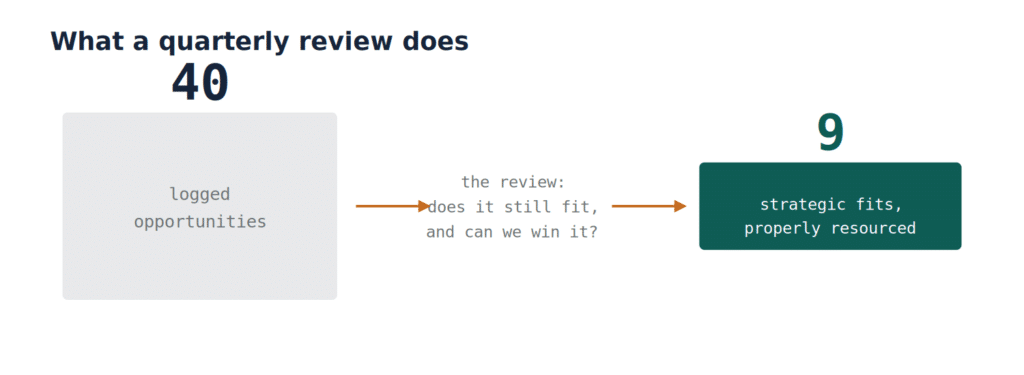
A pipeline is a living instrument, not an archive. Funders change priorities, deadlines pass, contacts leave. An honest quarterly review is mostly an act of removal: every opportunity has to earn its place again. The question is not whether it could still happen but whether it deserves a share of next quarter’s limited attention.
The organisations that do this well end each review with a shorter, clearer list. The ones that do it badly carry the same 40 items year after year; a museum of intentions nobody will act on.
The willingness to say no – on the record
None of this requires new software or a larger team. It requires the willingness to say no on the record, which is harder than it sounds when a board still equates a long pipeline with ambition. In a sector facing a contraction measured in billions, that equation is the thing to break. A pipeline is not a measure of how much you are pursuing. It is a measure of how clearly you have decided what you will not.
Interested in hearing more?
I highly recommend you join our upcoming webinar where my colleague Chris Meyer zu Natrup and other sector speakers will share details on some of the pressing issues we face today.
Register hereShould you like to talk more about the work we do at MzN International, get in touch via [email protected].
Related content

What will it take to make localisation a reality? Part two
Alexandra Newlands of the Scaling Up Nutrition Civil Society Network follows up on her previous blog about stalled localisation, asking whether decision-making and funding are actually moving closer to where impact happens.

Re-imagining the future of the INGO
Mary Ann Clements, co-lead of ADD, reflects on the changes the organisation has made so that funding can flow more freely and directly to disability justice movements in other countries.

Your website as a governance asset: managing risk during change and scrutiny
Why it’s time to stop thinking about your organisation’s website solely as a communications tool.

Category
News & viewsThemes
Funding