
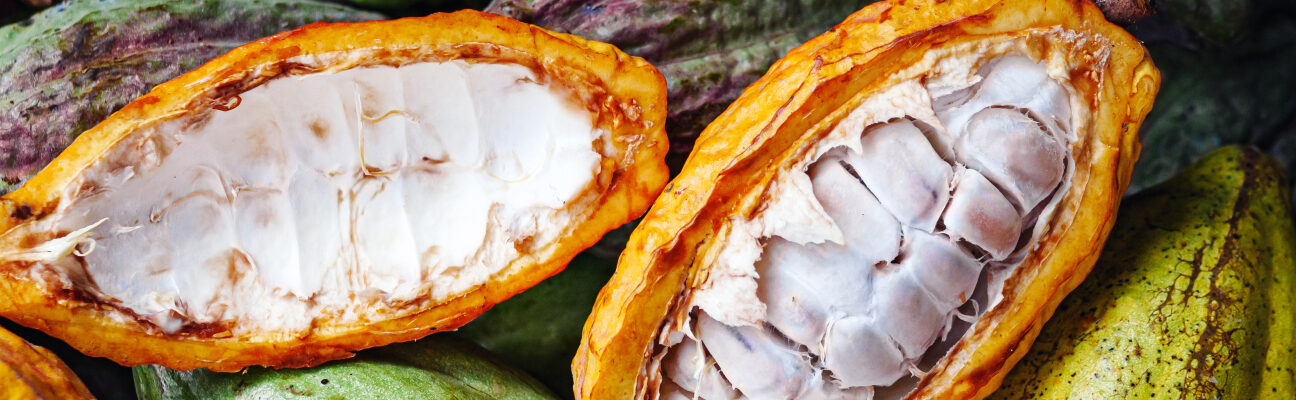
The bitter truth about chocolate: tackling water injustice in cocoa supply chains
The global chocolate industry depends on millions of smallholder farmers. Without them, there is no chocolate.
Yet despite this fundamental truth, the sector is defined by a deeply unequal, deeply predictable power balance. Household-name chocolate brands, mostly headquartered in high-income countries, generate enormous profits. Meanwhile, cocoa production, much of it concentrated in West Africa, remains strongly associated with extreme poverty, child labour and deforestation.
Now new Water Witness evidence reveals another hidden injustice at the heart of this value chain: widespread water poverty and escalating climate vulnerability.
Our research shows that cocoa-growing communities in Côte d’Ivoire – the world’s largest producer – often lack access to safe drinking water and sanitation. In many villages, families rely on unsafe streams, open ditches or shallow wells simply to survive.
This is not just a development failure. It is a systemic failure of global supply chains. How can such a basic human right remain unmet for those producing a raw material that generates vast wealth for big chocolate brands?
A profoundly unfair water footprint
Chocolate has one of the largest water footprints of any food product: producing a standard 100-gram bar requires around 2,400 litres of water. But a product’s water footprint is not only about volumes. It is also about how production interacts with local water security and other water impacts, including whether workers and surrounding communities have access to safe water, sanitation and hygiene.
Every cocoa-growing community we visited for our investigation did not have reliable access to safe drinking water and sanitation. The consequences of this are severe, particularly for women and girls: ill-health, lost income and missed schooling. These conditions undermine the sector’s claims of ethical and sustainable sourcing.
The stark contrast between industry profits and farmer living conditions exposes a deeply unequal distribution of risks and rewards within the chocolate value chain.
Climate shocks are pushing farmers to the brink
Climate change is rapidly intensifying this injustice. Cocoa farmers report increasingly erratic rainfall, prolonged droughts and destructive storms – profound water impacts that climate science has long predicted. Yields can fall sharply, in some areas by as much as 90%.
For many households, these shocks have devastating consequences. Falling incomes force families to withdraw children from school, delay healthcare or clear forests in a desperate attempt to sustain production.
Despite record profits and clear warning signs, major brands and traders have failed to invest at the scale needed to help farmers adapt. Proven measures, from climate-resilient planting materials to insurance schemes and improved agricultural services, remain largely out of reach.
Join Bond’s UK WASH network
This group aims to exchange knowledge, enhance analysis and coordinate advocacy on water, sanitation and hygiene issues.
Join the Working GroupWhy this is a human rights issue
Access to safe water and sanitation is internationally recognised as a fundamental human right. Yet our findings show this right is routinely overlooked in cocoa supply chains – even in communities linked to major brands and voluntary sustainability certification schemes.
This points to a wider systemic challenge. Consumption patterns in countries like the UK are too often directly connected to water insecurity, environmental degradation and social harm in producer nations – not only in chocolate, but across many sub-sectors of agricultural production.
Unless supply chains are fundamentally reset, the inequalities exposed in Côte d’Ivoire will deepen, and climate risks will continue to undermine livelihoods.
From evidence to action
At Water Witness, we believe the response must be both urgent and constructive.
Our research calls for action on many fronts. Critically, the chocolate sector must move towards a ‘fair water footprint’. It must embed water security, climate resilience and the rights to clean water and sanitation into corporate due diligence, procurement practices and sustainability standards. Governments and financial institutions also have critical roles to play in strengthening regulation and directing investment to protect communities vulnerable to water poverty and climate shocks.
This is why we are calling for stronger UK legislation on business, human rights and the environment. Through our new campaign, we are asking the public to urge policymakers to introduce effective human rights and environmental due diligence measures which require companies to prevent harm across their global supply chains.
Convening change across the sector
Political advocacy alone is not enough. Water Witness is also working to bring stakeholders together to accelerate practical solutions.
Last month, we convened a high-level roundtable in London involving cocoa traders, major brands, retailers, sustainability standards bodies, and Ivorian civil society organisations. The aim was to move beyond recognition of the problem towards concrete commitments, including investment in safe water access, climate resilience and fairer pricing for farmers. Constructive follow-up is now in motion with a range of stakeholders.
There is much to do to address entrenched harms in cocoa production, but tackling water poverty must be part of the solution. Sustainability claims ring hollow while the communities producing cocoa are denied their rights to water and sanitation. Creating a fair water footprint is no longer optional. It is non-negotiable. The goods we are sold cannot be driving human rights violations and environmental harm.
Related Content

Ecology and empowerment
How is ecology and empowerment linked when it comes to international solidarity? Contributors from seven countries have attempted to provide some answers to this question in a new book coordinated by the F3E network. Isabelle Moreau shares the key findings.
Scaling climate-resilient education: putting disability inclusion at the heart of sector adaptation
In the move to build “climate resilient” education systems, learners with disabilities are being programmed out of the climate response. Here, Hamish Higginson explores how Sightsavers practice what they preach in Bangladesh.

Why housing belongs at the centre of climate action
As policymakers, practitioners, researchers and advocates gather for London Climate Action Week, housing – one of the most powerful adaptation tools – remains largely absent from the conversation.

Category
News & views