
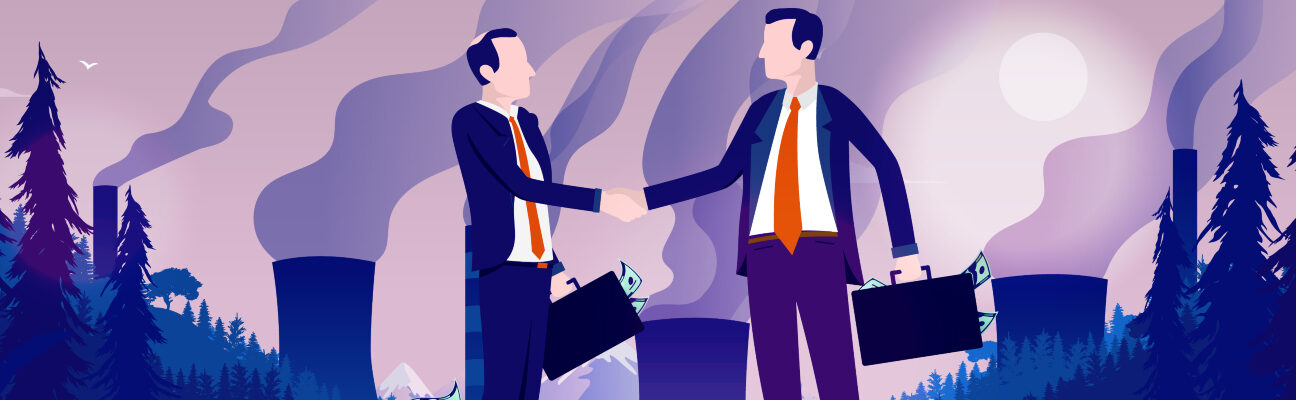
Shifting the balance of power: an urgent need for legislative reform to protect rights
There is no corner of the world untouched by corporate harm.
Deforestation, pollution of soil and waterways, biodiversity loss, union busting, the loss of land rights for Indigenous Peoples, forced labour, child labour – the impacts are myriad.
So much of this abuse can be linked back to the UK, where decisions made in boardrooms cascade through supply chains to wreak havoc on the ground. This is so devastatingly commonplace that it is no longer surprising, but it should never cease to shock us.
UK businesses that cause harm to people and planet through their operations and supply chains can, by and large, breathe easy – particularly if they choose to ‘offshore’ this abuse in third countries. Our laws governing corporate accountability are weak at best, and stunningly absent at worst. There is no incentive to prevent harm in supply chains, and little chance of accountability when abuses do occur.
What this adds up to is a system ripe for exploitation.
Some businesses, to their credit, do all they can to prevent harm. But many, many others do all they can to profit directly from it.
There is no justification for continuing this putrid status quo. We urgently need to shift the balance of power away from those businesses that unscrupulously profiteer from exploitation and environmental degradation, and into the hands of workers and communities.
A new proposal to challenge corporate harm
Change is possible. The government is actively reviewing the UK’s approach to ‘responsible business conduct’. Multiple parliamentary inquiries have highlighted the need for a mandatory human rights and environmental due diligence law to protect people and planet – and momentum is building among the public, policymakers, and many businesses and investors themselves.
That’s why, in the coming weeks, the Corporate Justice Coalition (CJC) – the UK’s largest civil society network on corporate accountability – will publish a Business, Human Rights and Environment Act (BHREA) model law. We have been campaigning for this law – a form of mandatory human rights and environmental due diligence legislation – for several years. We believe it’s the best way to hold businesses to account for the harms they cause to people and planet through supply chains. And because the proposed law reverses the burden of proof, it will also give victims meaningful access to justice by making it easier to take legal action against companies.
By publishing our own text of the law, we are putting our money where our mouth is to show what excellence would look like.
Centring rightsholders’ perspectives
Many years in the making, our legal text has passed through multiple expert hands and reflects a carefully iterative process.
Central to this process has been a consultation with those who suffer the blunt force of business harms: rightsholders in Global South nations. In 2025, we engaged representatives of more than 50 trade unions, civil society organisations and regional human rights bodies in Africa, Latin America and Asia. We did this to understand how a UK BHREA could help support workers, communities and the environment in Global South countries, and to refine our legal proposal in line with their recommendations.
This consultation complemented the extensive and brilliant work our partner organisations, Forest Peoples Programme and Peace Brigades International, conducted to understand what Indigenous people, Afro-descendant people and local communities experience at the hands of corporations, and what actions they would like the UK government to take to address these harms.
Both consultations show that action is desperately, urgently needed. All too often, impunity reigns over rights. Our engagement process confirmed that the complexity of business ownership structures, the use of opaque supply chains to diffuse responsibility, and divesting businesses after harm has occurred make the battle for justice one of David against Goliath.
These challenges are compounded by imbalanced power dynamics, unequal access to vital information which is necessary for accountability, and the risks that those who speak up about harm face.
Throughout our consultation, it was clear that a binding human rights and environmental due diligence law, which incentivises prevention on the part of businesses and makes achieving remedy easier for victims, is not a nice-to-have, but a necessity. But a new law will not end corporate harm on its own. To be effective, the new law must ensure that due diligence does not result in perfunctory compliance but a meaningful exercise in harm prevention. It must centre rightsholders in its development, and ensure that those who come forward as whistle-blowers – who are so often the target of violent reprisals – are protected. It must make multiple routes to remedy available, so that when harm occurs, meaningful redress can be achieved. And it must be enforced.
Recasting the UK’s place in the world
As the world reels from non-stop shocks, permacrises and geopolitical fallouts, policymakers can easily cast aside measures that centre rightsholders. But these measures are not just the obvious and urgent moral imperative; they will make the world less volatile. When people flourish, when the environment is protected and when workers are paid a fair wage and have dignified conditions, the conditions for a more politically stable world are created.
We believe our model law – if adopted – would address the rampant power imbalance between businesses on the one hand, and people and communities on the other.
Always open to feedback and insights, we remain willing for this initiative to be iterative. But where we will never compromise is on our dogged pursuit of a law that recognises the inseparability of human rights and environmental harms, and of the overwhelming need to ensure that businesses are responsible for their actions.
We are publishing our law now, following our consultation, to highlight that Britain and the UK government has a choice as it reviews its changing place in this changing world. We can risk making our defining characteristic the systemic pattern of profiteering from exploitation and environmental degradation by UK businesses. Or we can choose to act – and make the world a fairer, greener place.
The Corporate Justice Coalition is always open to new civil society members. If you agree that it’s time to end corporate abuse, join our movement for a Business, Human Rights and Environment Act.

Category
News & views