
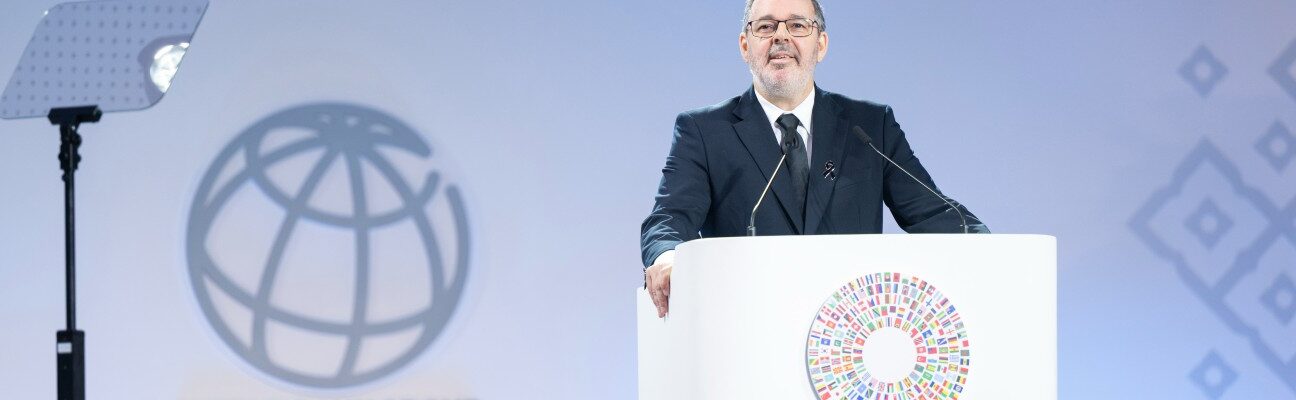
At the IMF-World Bank Annuals, the UK began to set out its G20 presidency priorities. Here’s what we learned.
Last week, Bond and several of its members travelled to Bangkok for the 2026 Annual Meetings of the International Monetary Fund and the World Bank Group.
The UK government sent a large delegation including Chancellor John Healey, Foreign Secretary Ed Miliband, and the Minister for Development, Kirsty McNeill. Ed Miliband is the first British foreign secretary to participate in the Annual Meetings as UK governor of the World Bank – a role typically held by the Minister for Development. With the UK’s G20 presidency upcoming, his presence signalled a welcome commitment to engaging with international partners on some of the most pressing issues of our time, including a broken global economic system which is keeping countries trapped in cycles of debt, poverty and underinvestment.
A new deal on debt requires new policy solutions
Together, the Foreign Secretary and Minister for Development came to deliver a clear and welcome message: that the global economy urgently needs a “new deal on debt”, including for lower-income countries.
Bond wholly agrees with the Foreign Secretary that countries need assistance to free up budgets so they can spend more on public services, and welcomes his commitment to using the UK’s upcoming G20 presidency to fix the broken global debt system.
Debt is one of the main reasons that many low- and middle-income countries cannot adequately fund public services or invest in responding to the threat of climate change. Debt also contributes to low global economic growth.
But delivering on a new debt deal that enables growth, tackles poverty and creates space for climate investment requires some new policy solutions. A repackaging of approaches that rely on private creditors to voluntarily fall in line, or that risk bailing out reckless private lenders with public money, will not move the needle.
We welcome the acknowledgement from ministers this week that bold political leadership is needed to tackle this global debt crisis, and call for an overhaul of the G20 Common Framework for Debt Treatments to provide deeper debt relief, as well as action to compel private creditors to participate in debt restructuring negotiations on the same terms as other lenders. We look forward to learning more about what renewed ambition from the new UK government looks like in practice.
The Foreign Secretary is right that bringing private creditors to the table on debt restructuring is essential. Private lenders are now the largest creditor group globally, and often charge higher interest rates to the lowest-income countries than those available to richer countries. Since 2022, these creditors have received over $141bn more in repayments from lending to developing and climate-affected economies than they have lent. Thirty-two African countries spend more on external debt payments to private creditors, including wealthy banks and hedge funds, than they do on their health and education systems combined.
To tackle this challenge of private creditors, we urge the government to adopt UK legislation that would compel these creditors to participate in debt restructuring negotiations and prevent holdout behaviour that slows and blocks efforts to provide genuine debt relief. The vast majority (90%) of debt that low-income countries owe to private lenders sits under English law. A legislative fix, to close the loophole that lets private creditors sue for full value in UK courts after pricing in default risk, would speed up debt relief. It would also strengthen the UK’s hand in reforming the G20 Common Framework, in line with Gordon Brown’s 2010 legislation. These actions would build on the UK’s historic role in debt relief, while updating the legal framework for a fundamentally changed global debt landscape.
Bond partners Save the Children UK and Debt Justice UK have outlined six practical reforms needed to make the Common Framework faster, fairer and more effective, based on the African Union’s Common African Position on Debt.
Ending tax havens and addressing illicit financial flows
In his speech in Bangkok, the Foreign Secretary’s reference to tax havens and illicit financial flows was also very welcome. The global tax system allows enormous amounts of wealth and corporate income to escape taxation. This enables corruption and deprives countries of the resources they need to adequately fund public services and invest in their futures. The UK and its overseas territories sit at the heart of this system, facilitating an estimated 25% of global tax evasion – worth over $100bn a year..
The UK could take meaningful steps to address this issue by driving through fully public, accessible and transparent registers, detailing the beneficial owners of companies registered in British Overseas Territories. The government should also use its upcoming G20 presidency to support international efforts towards a global minimum tax on extreme wealth, and advocate for solidarity levies and taxes on wealthy polluters in line with the “polluter pays” principle.
Subscribe to our newsletter
Our weekly email newsletter, Network News, is an indispensable weekly digest of the latest updates on funding, jobs, resources, news and learning opportunities in the international development sector.
Subscribe nowPrivate capital mobilisation
Private capital mobilisation (PCM) was another focus of the Annual Meetings this year and is also high on the UK government’s agenda ahead of the G20.
We echo the Foreign Secretary’s call for more data and transparency from multilateral development banks (MBDs). PCM continues to dominate the strategies of MDBs and development finance institutions (DFIs). Yet MDBs’ disclosure of PCM data is still limited to various levels of aggregation, which undermines the ability of civil society and citizens in emerging economies to assess its efficacy. Disclosure of project-level data is critical for understanding the impact of private sector mobilisation in driving economic transformation and supporting wider development goals.
Private capital is a critical tool in the development toolbox when done right. However, past efforts on PCM have failed to deliver promised progress on sustainable development. More evidence-driven and development focussed approaches will be essential to ensure concrete development outcomes in the future. Despite acknowledgment from World Bank President Ajay Banga that the “Billions to Trillions” agenda was “unrealistic”, it remains unclear how the World Bank and its shareholders, including the UK, plan to draw on the learnings from this agenda and address past challenges.
Bond and our members are concerned that the politics has run ahead of the evidence in this area, particularly regarding the scale of finance that can be mobilised and where the benefits will be felt. Statistics for MDBs and DFIs for 2015-2024 show PCM has largely been concentrated in middle-income countries (45% in upper middle-income countries), with only 9% in least developed countries , and it has largely focussed on sectors with commercial returns rather than on basic services like education and healthcare. Interest costs on this finance have also squeezed fiscal space and prevented investment for growth.
While much of the conversations in Bangkok continued to focus on the quantity of PCM, important questions are still to be answered about what PCM can achieve and for whom, as well as whether these investments helps to strengthen domestic institutions and markets. The answers to these questions shouldn’t be left to retrospective assessments; they should drive decisions on where, when and how to use private finance approaches and instruments to best support development and poverty reduction. At this critical moment we can’t risk the hype around PCM diverting political attention and resources away from the countries and sectors that urgently need to mobilisedomestic and international public finance.
As we look ahead to its 2027 G20 presidency, the UK has an opportunity to show leadership on a responsible, nuanced and evidence- based approach to private finance. The UK government must also use its presidency to turn words and intent into action and outcomes that reform the broken global debt system, secure fairer tax rules and crack down on flows of dirty money, helping to build a fairer global economy for us all.
Bangkok was a promising first step for the UK government in setting out its vision for bold and much-needed economic reforms. We look forward to continuing to engage with the UK government to make this vision a reality.
Bond member and partner perspectives on the ground in Bangkok
The IMF’s October World Economic Outlook is clear: ‘liquidity support is not a substitute for timely and orderly debt resolution’ – yet communities continue to pay the price for delays, with public money diverted from schools, healthcare and livelihoods to debt repayments. As Ed Miliband says, ‘we’ve got to improve the debt architecture’ so private lenders cannot block restructuring. The UK’s G20 presidency must turn that commitment into action, with UK debt legislation and urgent reforms to the Common Framework, because voluntary approaches are no longer enough.
Osai Ojigho, Head of Policy and Influencing, Christian Aid
The Foreign Secretary is correct: the global financial system is failing the countries that need it most. Extreme poverty is concentrated in fragile and conflict-affected states, yet people living through crisis are too often shut out of international support. What’s more, this extreme poverty is exacerbated by global shocks. In the last few months alone, we’ve seen conflict disrupt shipping through the Strait of Hormuz, driving up the cost of moving food, fuel and fertilizer to food-insecure countries just as El Niño peaks.
International Rescue Committee
In this era of compounding risks, there were promising announcements at the Annual Meetings. The UK’s decision to focus its G20 Presidency on resilience is very welcome, and increasing pre-arranged finance will greatly improve readiness for climate shocks. The next steps for IDA [the World Bank’s International Development Association] were also under discussion as a key lifeline for countries facing conflict, fragility and the climate crisis. The IRC calls on the UK to keep fragility and conflict on its G20 agenda, alongside IDA22 replenishment and a deepening of World Bank partnerships with local responders in fragile and conflict-affected settings.
International Rescue Committee
The Foreign Secretary has acknowledged that Africa loses around $90 billion a year to illicit financial flows, and the global financial architecture is marked by imbalances of power. Ongoing negotiations of an UN Framework Convention on International tax Convention seek to correct these structural inefficiencies, with African countries pushing for fairer taxing rights. The UK has instead opposed majority-based amendments in the negotiations so far. The UK should use its G20 presidency to step up the fight against illicit financial flows, as pledged by G20 leaders in 2025 during South Africa’s presidency, and back a UN Tax convention that lets African countries tax profits where the economic activity happens to prevent resource leakages.
Afrodad
Related groups
Related dontent
At the IMF-World Bank Annuals, the UK began to set out its G20 presidency priorities. Here’s what we learned.
Last week, Bond travelled to Bangkok to attend the IMF-World Bank Annual Meetings. Here, Bond’s G20 and Global Reforms Manager, Maria Finnerty, and Policy Manager for Development Finance, Alex Farley, share their reflections on the UK government’s announcements at the event.
 Briefing
Bond briefing on the UK’s 2027 G20 presidency
With the UK’s 2027 G20 presidency fast approaching, the government has a historic opportunity to champion the global financial reforms…
Why is debt restructuring important?
Save the Children UK and Debt Justice UK outline the six critical reforms needed to fix the G20 Common Framework, the mechanism lower-income countries can use to restructure their debts.

Category
News & views