
Six pathways to creating change: a fresh way to understand government responsiveness and civil society impact in fiscal governance
Anyone working closely with civil society organizations knows there is a form of impact that rarely gets acknowledged.
It is the work of staying engaged when political conditions are hostile. Of building relationships that will only matter when an opportunity finally emerges. Of keeping a reform conversation alive when progress feels impossible. This is the kind of work that makes policy change possible, that creates the conditions for new participation mechanisms to take hold and that incentivizes oversight actors to step up. It is not marginal. In many contexts, it is the work. And yet it is almost entirely absent from the way the field currently understands and measures impact.
The independent evaluation of our Collaborating for Open and Accountable Budgeting (COAB) initiative, conducted by Czarina Medina-Guce, Victoria Therese Tsui and Francis Capistrano drew on an existing framework to begin addressing this gap. Drawing on the Six Models of Impact developed by Liz Ruedy at the Democracy Fund in 2018, originally in the context of democracy work, the evaluation adapted and applied this framework to examine how civil society advocacy contributes to change in fiscal governance systems.
This blog covers three things: the six impact pathways themselves, what applying them revealed about how government responsiveness works in practice and what the evaluation found about what actually drives sustained impact.
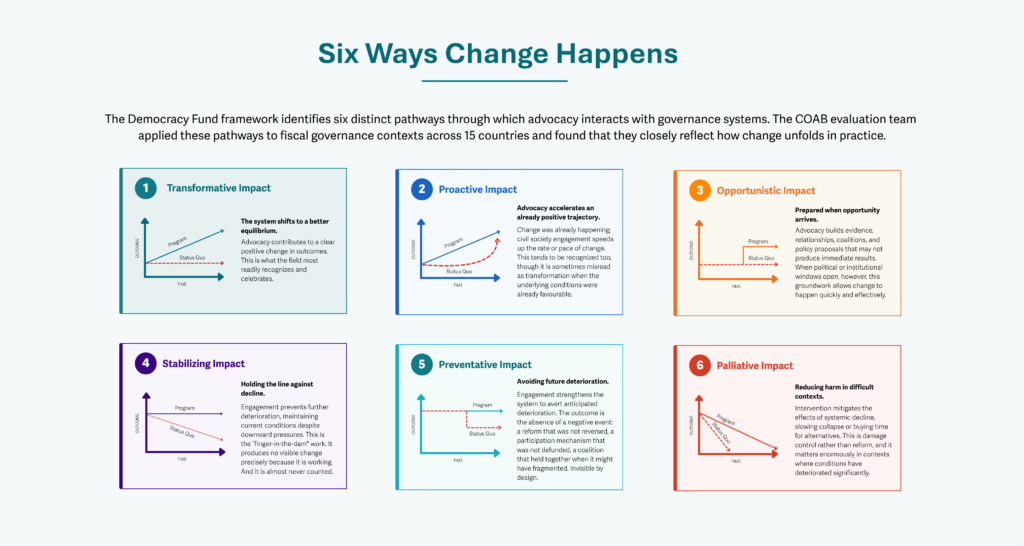
Across the 15 countries covered by the evaluation, five of these change pathways were observed in practice. Preventative impact was not observed as a distinct pathway during the evaluation, although elements of preventative action were visible within broader engagement strategies. In most country contexts assessed, the initiative was found to have created the conditions for building, deepening and sustaining civil society engagement with government counterparts.
Why This Framework Matters
These six impact pathways expand the vocabulary for describing what civil society engagement can achieve. In many countries covered in this evaluation, the most accurate description of impact was not transformative but stabilizing or opportunistic given wider governance challenges. This is not unfamiliar to so many in the democracy, rights and governance field who work within imperfect systems—what is remarkable however is how much can still be protected and advanced in open budgeting practices despite these broader governance challenges; this framework helps us explain these important forms of impact.
Civil society organizations are operating in environments where formal participation channels are limited, political receptivity to reform is low, or institutional constraints shape what is possible. In these contexts, sustaining engagement, preserving capacity, and maintaining relationships is the strategic work that makes future change possible.
This has direct implications for how programs are designed and evaluated. If the only form of impact that counts is transformation, then programs operating in constrained environments will consistently appear to “not deliver on impact”, and the organizations doing the hardest work in the most difficult conditions will consistently be undervalued. This framework offers a more honest and more useful alternative: one that makes the breadth of civil society work visible, and gives funders and evaluators a more accurate basis for assessing what is actually being achieved.
Many governance spaces are dynamic-and sometimes significant political openings for reform do appear—but if we don’t invest in the hard, quiet, long-term engagement work that is needed ahead of these openings, we are unlikely to reap the gains when a political moment opens.
Government Responsiveness as a Spectrum
Applying Democracy Fund’s framework to this evaluation helped the International Budget Partnership and our partners develop a richer understanding of what government responsiveness actually looks like in practice. Rather than a binary (either government responds or it doesn’t), the evaluation revealed that responsiveness operates across three distinct dimensions:
- Form: whether it is embedded in formal institutional structures, occurs through regular but non-institutionalized interaction, or depends entirely on the discretion of individual officials.
- Intensity: whether government deploys real policy capacity in response to civil society engagement or offers only symbolic acknowledgement.
- Impact Pathway: whether the response reflects a trajectory of genuine transformation, careful navigation of opportunity, or the quieter work of holding ground.

Understanding responsiveness this way shifts the question from “did government respond?” to “how did they respond, and what changed as a result?” In the 15 countries assessed, these questions served as a much more useful basis for interpreting results across the diverse contexts in which our partner civil society organizations work.
Crucially, the form and intensity of responsiveness a civil society organization can expect is shaped by which impact pathway it is operating through. Where engagement is institutionalized and recurring, more structured and consistent government responsiveness becomes possible over time. Where engagement is networked and coalition-based, responsiveness tends to be more relational and shaped by evolving opportunities for engagement, dependent on the strength of relationships and the ability to act when institutional windows open. And in contexts where the impact pathway is stabilizing, the evaluation suggests that even low-intensity responsiveness, a government that stays in dialogue, is itself a meaningful and hard-won outcome.
What Actually Drives Sustained Impact
The six pathways and the responsiveness spectrum tell us what impact looks like. The evaluation also surfaced important findings about what drives it, and here the coalition and networked engagement findings become central.
Across the 15 countries, the evaluation found that the impact pathway a civil society organization lands in is shaped significantly by how it is organized and how it engages. Technical capacity matters. It functions as an entry point, enabling civil society actors to engage substantively in policy discussions. But technical capacity alone does not produce sustained responsiveness. What makes the difference is the ability to coordinate across organizations, to build and maintain coalitions that help drive public demand for reform and to sustain relationships with government counterparts over time.
This showed up clearly across the two pathways the evaluation identified as most consistently associated with sustained government responsiveness. In contexts where formal engagement mechanisms existed, including technical working groups, budget consultations, and parliamentary processes, sustained responsiveness emerged through repeated interaction and the gradual incorporation of civil society inputs into policy processes. In contexts where formal channels were limited or absent, it was the strength of civil society networks and coalitions that enabled influence, creating access points and amplifying voice in ways that individual organizations could not achieve alone.
In both cases, what sustained impact was not a single output or a strong technical report. It was the infrastructure of relationships, coordination, and collective action that kept civil society present and credible within governance processes across political cycles and changing conditions.
This has direct implications for how programs like COAB think about sustainability. The sustainability of impact depends less on individual outputs and more on the strength of the underlying civil society ecosystem, including the networks, coalitions, and relationships that allow organizations to stay engaged, adapt their strategies, and maintain influence even when conditions are difficult.
Where those ecosystems are strong, even modest program inputs can sustain engagement and open new opportunities. Where they are fragile, gains are harder to protect.
The larger lesson for the field and donors
The vocabulary we use to describe impact shapes what we value, what we fund and what we ask civil society organizations to achieve.
A field that only recognizes transformation will consistently underfund the stabilizing, preventative, and opportunistic work that makes transformation possible over time. The evaluation’s application of this framework will not resolve this on its own. But it offers a more complete picture of what government responsiveness looks like in practice, and a more grounded basis for the conversations the field needs to have about what we are trying to achieve and how we know when we are making progress.
In moving public finance systems toward more equitable and accountable outcomes, the long game matters. The Democracy Fund’s framework, applied here to fiscal governance, helps us see it.

Category
News & views