
Is power really shifting? Yes… and no
This is a reflection exercise. Close your eyes, take a deep, critical look within and ask yourself: is power shifting in the development and humanitarian space?
What is your answer?
If you’re anything like us you might say a little bit, hardly, not nearly enough.
Ask that question to a room full of development industry representatives at a conference in the Global North, and you get a different answer.
At the Global Partnerships Conference in London, during a session on shifting power and celebrating civic leadership, when asked if power is shifting (on a scale of 1-4), a slim majority of delegates answered 3: “somewhat”.
The panellists challenged this idea. Two young female Global South leaders – Marian Nourya Kone, Founder of Hackily, and Sonali Silva, Co-Director of Yield Hub – spoke of the lack of respect, funding and decision-making power currently afforded to local organisations, let alone women-led and youth-led entities.
Asif Saleh, Executive Director of BRAC, gave a stark example of the continued lack of power shifting in the sector. Recently the UN’s Office for the Coordination of Humanitarian Affairs allocated US $150 million to the Rohingya humanitarian response. A staggering 92% went to other UN agencies and 8% to INGOs. None went to local actors.
OECD data shows that roughly 1% of development funding goes directly to CSOs in global majority countries. Sit with that: 1%. Is that a context where power is really shifting?
So it’s not just a matter of perspective. Lived experience and hard data show how little things have changed.
What does it look like to really see power shifting?
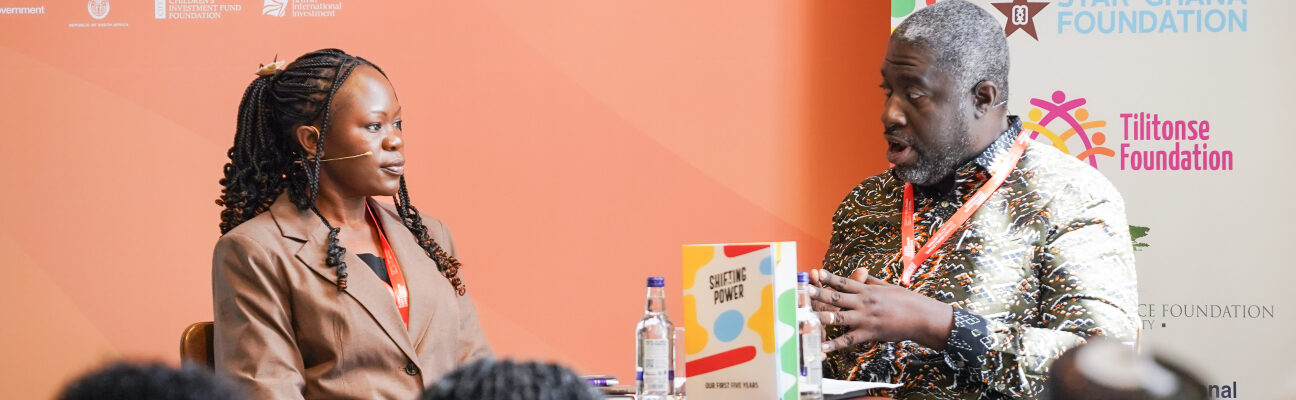
In another corner of the Global Partnerships Conference, a live recording of the Alternative Convos podcast delved into one such story.
Development often begins with survival
Charles Kojo Vandyck, host of the Alternative Convos podcast and Head of Capacity Development at WACSI, sat down with Patricia Mtungila, founder of Purple Innovation for Women and Girls in Malawi, to reflect on what “shifting power” truly means in practice.
He asked her directly – is power really shifting?
“Yes… and no” she said. Her story explains why.
Patricia’s story began in northern Malawi in 2016. At the time, many young women faced limited opportunities after secondary school. Restrictive university quotas, poverty and unemployment pushed many into unsafe work environments, exploitation or early marriage.
Seeing this reality firsthand, Patricia founded Purple Innovation for Women and Girls to create alternative pathways for young women and communities with limited opportunities.
But like many grassroots organisations across Africa, the journey was extremely difficult.
For nearly nine years, the organisation operated in what Patricia described as “square zero”, constantly starting over, surviving from one short-term grant to another, and relying heavily on personal sacrifice. Funding often covered activities but not the systems needed to sustain the organisation itself.
There was little room to think strategically.
No support for operational costs.
No resources to strengthen governance.
No long-term investment in organisational health.
No flexibility to adapt when realities changed on the ground.
The organisation was working hard to solve community problems while simultaneously struggling to survive internally.
Sadly, Patricia’s story reflects many local organisations’ experiences across the Global South.
From surviving to thriving
Shifting power is not only about transferring money. It is about transferring confidence, agency and decision-making space to local actors. Through the Comic Relief and FCDO-supported Shifting the Power programme, Purple Innovation began receiving support not only for projects but also for organisational strengthening.
For the first time, the organisation could hold consistent board meetings, develop a long-term strategic plan, strengthen internal systems and invest in resource mobilisation capacity. These may seem like small operational details, but they are the foundations of sustainability.
Strong institutions are not built through activities alone. They are built through long-term investment in systems, people, leadership and organisational health. This investment enables organisations to focus on what really works. But this is still an exception to how the development system works.
Locally-led change is lasting change
Patricia knows enabling CSOs to exercise their own power is not enough. Instead, local communities and leaders need to be at the centre. That’s why Purple Innovation worked closely with traditional chiefs to address gender-based violence and early marriage. Through dialogue and community engagement, local bylaws were established to discourage school dropouts and early marriages.
Even after the original funding ended, these bylaws remained active. Why? Because the community owned the process.
The intervention was not imposed externally. It became embedded within local structures, culture and accountability systems. This is a clear example of what locally led development can achieve when communities move from participation to ownership.
The future of development – and partnerships – must look different
The international development sector is facing major uncertainty. Funding cuts, geopolitical tensions, economic instability and donor fatigue are reshaping the landscape. But the podcast conversation reframed this, arguing that we need to see this moment differently.
Instead of seeing this crisis only as a threat, it is an opportunity for local organisations to rethink sustainability, partnerships and resilience.
Patricia spoke about building stronger domestic philanthropy, engaging the African middleclass and high net-worth individuals, creating private-public partnerships and strengthening local resource mobilisation systems.
In the meantime, while external aid flows are reducing, what little is left must be spent better. Investing in local organisations and local communities to become their own change agent means that change will last.
The future of African civil society cannot depend entirely on external aid flows. Long-term resilience will require stronger local ecosystems of support, financing and ownership.
The challenge now is whether development actors are willing to genuinely redistribute trust, authority and ownership to the communities closest to the issues.
Ultimately, real transformation will not happen if communities keep being treated as beneficiaries. It happens when they are trusted as leaders.

Category
News & views