
Participation in practice: co-creating inclusion resources with disability-led organisations
Making sure ‘no one is left behind’ begins with practising meaningful participation.
When resources are stretched and priorities are evolving, organisations can strengthen their impact by including people with disabilities at every stage of decision making. This means creating space for people who are often excluded to share their perspectives, priorities and the outcomes they want.
Organisations of Persons with Disabilities (OPDs) have the knowledge to make inclusion practical and effective. When we listen to OPD expertise, programmes become more responsive, relevant and grounded in lived experience.
Visualising inclusion
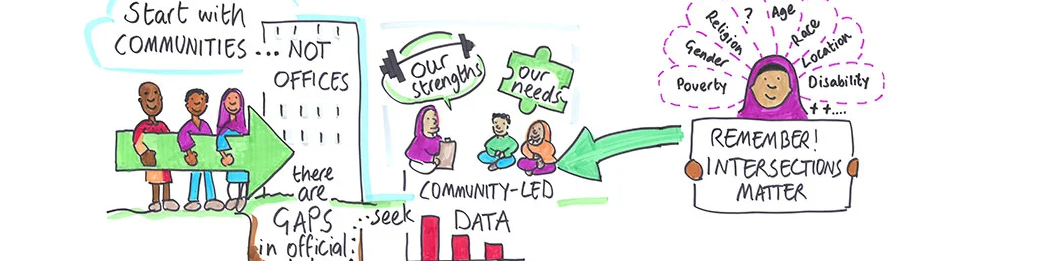
A new visual resource, Disability Inclusion: Actions for Change demonstrates how this can be achieved. The illustration was co-created by OPDs in Bangladesh, Kenya and Nepal. It puts OPD expertise and insight at the heart of defining what disability-inclusive development looks like. CBM UK supported its development while OPDs shaped the content and direction.
The result reflects what OPDs have long said. Inclusion only becomes real when those most often excluded are genuinely heard and involved from the start.
Development organisations must listen differently
OPDs stressed that exclusion often happens not because of bad intentions, but because organisations are not listening closely enough.
OPDs are close to their communities, so they know who is left out, why they are missed and what it takes to reach them. OPDs stressed the importance of seeing disability alongside other identities. Gender, for example, came through strongly in these conversations. OPDs explained that the experiences of women and girls with disabilities often remain hidden. Social norms, safety concerns and household responsibilities limit their visibility and voice.
But gender is only one part of the picture. Age, religion, ethnicity, poverty and where someone lives all shape people’s lives. These overlapping factors can make people not just hard to reach but completely invisible in mainstream programmes.
For development organisations to reach those who are unheard, they must change how they engage. This means:
- understanding who is being left out and why
- taking practical steps to reach and listen to those most marginalised
- designing systems that acknowledge multiple barriers
- moving beyond box ticking toward genuine participation
- recognising the benefits to everyone when inclusion is done well.
The illustration brings these principles to life. It shows that inclusion is not just a checklist or set of technical requirements. It is a mindset grounded in humility, curiosity and respect for lived experience.
Developing a co-created and co-owned resource
To create the new resource, three of our OPD partners – BYAN (Nepal), NONDO (Kenya) and NGDO (Bangladesh) – shared the approaches they use to include people who are excluded. They described how they’ve learnt to create safe and comfortable ways for people to share their experiences, how they sustain relationships, how they act on what is shared and how they foster inclusion. CBM UK then worked with these partners and an illustrator to turn these insights into a co-owned visual resource.
The resource is screen-reader accessible, and each OPD is free to use it as they wish – in their own advocacy, awareness raising and fundraising.
A practical roadmap for disability inclusion
The illustration is made up of three interconnected sections. It provides a practical roadmap for disability inclusion which is grounded in local expertise.
- Foundations for change.
For OPDs, the principles that underpin inclusion are humility, collaboration and respect for lived experience. These are not abstract ideas. They are the ethical commitments OPDs expect the development sector to uphold. - Design for change.
Inclusion must look at the whole person. This means considering the multiple factors that shape someone’s experiences. For OPDs, designing with people with disabilities means starting where people live – in communities, not in offices. - Implement change.
OPDs show what sustained, meaningful participation looks like in practice.
Inclusion requires more than intention
Through this co-creation process, we have developed an accessible and practical communication tool grounded in lived experience. It gives policymakers and practitioners straightforward, actionable guidance. And it reminds us that disability is never a single or uniform experience.
Inclusion means making visible those who are unseen. It also means recognising the barriers that limit people from taking part in programmes that are supposed to be for them.
If the sector is serious about leaving no one behind, inclusion must be resourced, practised with humility and shaped by local priorities and lived experience, rather than institutional convenience.
The illustration is both a guide and a call to action. It’s a visual reminder of what’s possible when people with experience of exclusion shape inclusive practice. When they are listened to and their insights shape decisions, the impact is profound. Families feel respected, individuals gain confidence and communities get stronger.

Category
News & views