

What we’ve learned from eight years of outcome harvesting
How do you understand your impact when your organisation works across many different areas?
This was the challenge Frontline AIDS was facing. We work across advocacy, human rights, service improvement, capacity building and knowledge sharing. Using a different approach for each area of work would have been confusing, resource-intensive, and made it difficult to paint a picture of our impact as an organisation. We needed a consistent way to understand and communicate the changes we were contributing to.
At the same time, we were finding that traditional M&E approaches, such as logical frameworks, did not always fit the nature of our work. They were useful, but they did not always tell us the whole story. In areas such as advocacy, we do not always know at the beginning what changes will occur or where the opportunities for influence might emerge. Some of the most significant outcomes can therefore be missed by approaches that focus only on predefined results.
Why we adopted outcome harvesting
We first heard about outcome harvesting through Saferworld at a Bond Monitoring, Evaluation and Learning meeting in 2018. This approach resonated with us for a number of reasons. It is flexible, focuses on the higher-level changes we are trying to influence, recognises that change is rarely achieved through one actor alone, and works well in programmes where the results are not fully defined from the outset.
Rather than starting with a predefined set of indicators, outcome harvesting starts with a change that has happened, then works backwards to determine why it matters, who contributed to it and how. It gave us a common framework for describing outcomes across very different areas of work, understanding their significance, and reflecting on Frontline AIDS’ contribution alongside that of partners and other actors. It also helped us capture unexpected outcomes.
Outcome harvesting has become a core part of how we understand our impact. It helps us identify which approaches contribute to change, supports learning and adaptation and provides evidence for reporting and communications.
What we’ve learned
- Outcome harvesting helps us understand impact across different areas of work
One of the greatest benefits of outcome harvesting has been its ability to help us see beyond individual projects and understand Frontline AIDS’ contribution as a whole. By documenting outcomes in a consistent way across different programmes and workstreams, we can identify patterns that cut across different areas of our work.
This was particularly evident in our 2025 strategy evaluation, which drew heavily on outcome harvesting. Looking across outcomes from different programmes and regions helped us identify a common thread in how Frontline AIDS contributes to change. The evaluation found that our added value often lies in connecting community-led knowledge, experience and solutions with the systems and institutions that shape HIV responses. This can involve supporting communities to access decision-making spaces, translating community experiences into evidence that can influence policy or bringing together the relationships and resources needed to sustain change.
Embedding outcome harvesting within programme evaluations has strengthened this even further. Using a consistent approach across organisational monitoring and evaluations allows us to build a richer picture of change over time and across different areas of work. We have used outcome harvesting as a core evaluation approach in programmes such as REACH and Nadoum, as well as in our recent strategy evaluation, helping us generate evidence that is both programme-specific and relevant at an organisational level.
Looking across outcomes in this way helps us understand not only what has changed, but how change happens and where Frontline AIDS adds most value. - Change takes time
One of the most valuable insights from outcome harvesting has been seeing how change unfolds over time.
In some cases, outcomes harvested today can be traced back to programmes, partnerships and conversations that began many years earlier. This highlights the importance of sustained engagement and reminds us that meaningful change often continues long after a programme has formally ended.
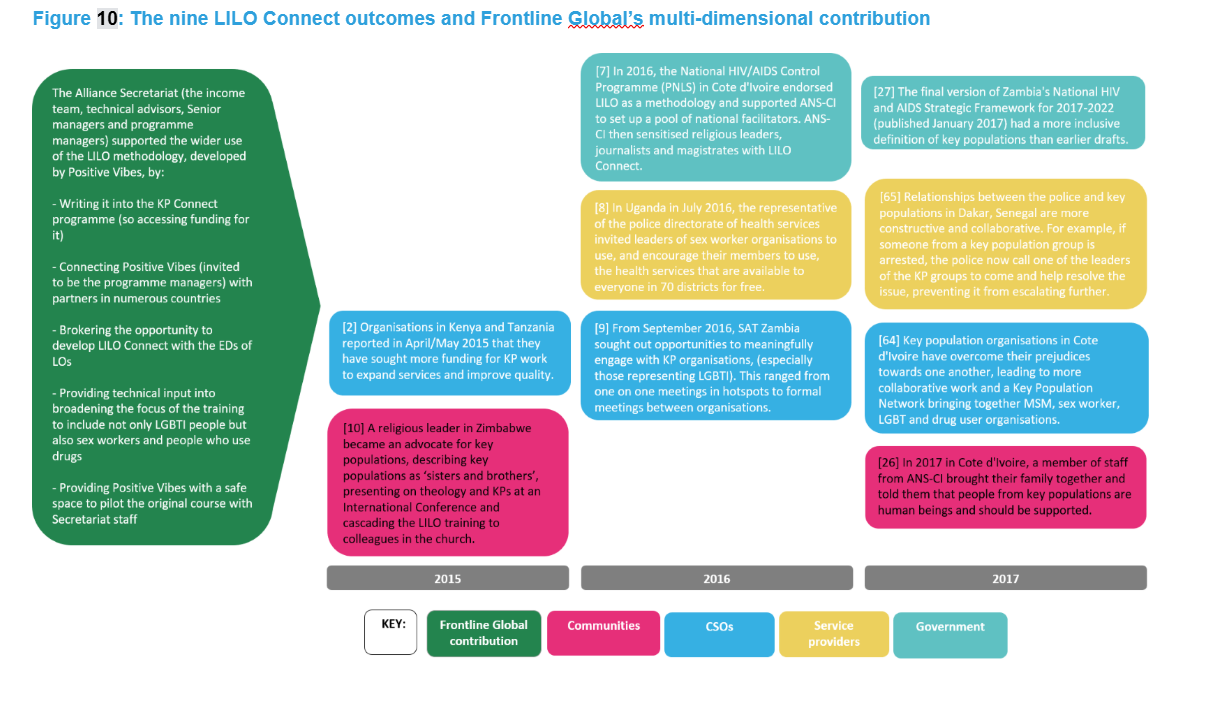
One example is the adoption of the Looking in, Looking Out (LILO) approach in Senegal, which supports personal and organisational development to address stigma and discrimination. The LILO methodology was first developed by Positive Vibes, and Frontline AIDS helped connect Positive Vibes with other partners through a regional programme and supported its wider use. Though this programme, a Frontline AIDS partner in Senegal learned about the approach in 2017 and subsequently used it to train healthcare professionals and bring together key stakeholders in the HIV response. The methodology was adopted by Senegal’s Global Fund Country Coordinating Mechanism in 2018 and later integrated into the country’s national HIV strategy in 2022. In 2025, it was referenced by the Senegalese Ambassador to Switzerland.
Several connected LILO outcomes were mapped as part of a previous outcome harvest, highlighting how ideas and approaches can continue to influence policy and practice years after they were first introduced.
- Sensemaking is where much of the learning happens
Collecting outcomes is only one part of the process. Some of the most valuable learning happens during sensemaking, when colleagues come together to discuss the outcomes and identify patterns and trends.
These conversations often reveal that outcomes are rarely experienced in the same way by everyone involved. In one discussion, a policy-related outcome that initially appeared highly significant was ultimately rated to have lower significance because colleagues felt it had not yet translated into meaningful change in people’s lives. At the same time, outcomes that seemed relatively small on paper sometimes proved to be highly significant because of their wider influence on relationships, trust or future opportunities
Bringing together different perspectives helps us challenge assumptions and build a richer understanding about how change happens. We’ve found these discussions to be both enjoyable and useful. They strengthen the quality of our analysis, but just as importantly, they create space for reflection and learning.
What we’re still improving
After eight years, we are still learning and refining our approach.
One challenge is the time it takes to develop good outcome statements. Clearly describing what changed and why it matters can take several rounds of feedback and revision. We want outcomes to be useful, but we are also conscious of the time this takes for partners and programme teams.
We also continue to navigate the issue of how much detail is enough. Finding the right balance between quality and practicality remains an ongoing challenge.
Despite these challenges, the benefits of this approach are clear. Outcome harvesting has helped us understand our contribution across diverse areas of work, uncover long-term pathways of change and create space for collective learning and reflection. Our use of outcome harvesting continues to evolve, and we continue to adapt and refine our approach as we learn more.

Monitoring, Evaluation and Learning
Bond provides a range of tools and resources to help organisations monitor and evaluate their work, aiding learning and accountability.
Are we measuring what matters?
Lydia Powell of Tearfund introduces the Light Wheel, a proven participatory toolkit that helps communities define wellbeing on their own terms, plan for holistic change and measure what matters most.

Balancing expectation and reality: evolving our approach to evaluating advocacy
Frontline AIDS has been wrestling with a myriad of monitoring, evaluation and learning questions in an increasingly unpredictable and difficult environment in recent years. Here, they share some of their learning.

Category
News & views