
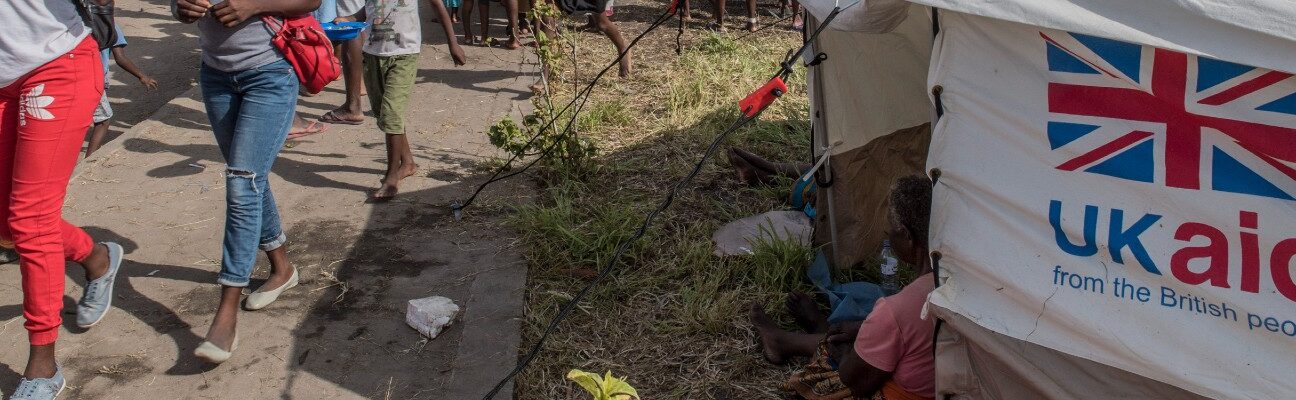
New FCDO Annual Report lays bare devastating cuts to the poorest and most fragile countries
Last week the FCDO published its FCDO Annual Report & Accounts 2025-26, giving an overview of the department’s programme ODA budget outturns for 2025/26 and forward-looking budgets from 2026/27 – 28/29.
The Annual Report includes a long-awaited list of country allocations for the next three years, making this the first time since the cuts to UK ODA to 0.3% of GNI by 2027/28 were announced last year that we have a clear picture of where the cuts will fall – and it is a devastating picture.
Some country programmes have virtually been shredded to pieces
We already knew from the regional ODA allocations published this March that Africa and the Middle East and North Africa (MENA) will be hit the hardest by bilateral cuts to UK ODA. What we didn’t know was which countries would bear the brunt of these cuts.
Overall, the FCDO’s bilateral regional programme budget will fall 43% by 2028/29 from its pre-cut levels in 2024/25. Ten out of the 17 African countries that received direct ODA support will barely have any budget left by 2028/29 (£5m). This includes Malawi and Mozambique which will see their direct funding reduced by 90% from pre-cut levels. We have been informed by the FCDO that the aim of these small budgets is to allow the department to continue supporting countries without large humanitarian needs by implementing the ‘four essential shifts’ through smart, catalytic finance.
While Sudan, Ukraine and Palestine have their budgets protected, as set out by the government, other fragile and conflict-affected states (FCAS) will see drastic reductions. The Democratic Republic of Congo, despite facing a deadly Ebola outbreak, will see its budget reduced by over £34m – a reduction of 29% from pre-cut levels. Somalia continues to face a severe humanitarian crisis, yet direct UK support will be cut by 49% (£66m) by 28/29In South Sudan, despite two-thirds of its population projected to require humanitarian assistance in 2026, UK ODA is gradually being reduced to 46% less than pre-cut levels.
The government rightly set out that it will prioritise FCAS by increasing the share of all country and regional spending going to FCAS to 70%. However, despite this increase in percentage share, total UK ODA to FCAS will still fall by 34% (to £655m). And least developed countries (LDCs), some of which are also FCAS, will see a 49% decrease (£766mn) between 2024/25 and 2028/29.
The reality of such significant overall budget cuts means that, even with prioritisation, the countries and communities that most need support will experience devastating shortfalls.
While the government expects that the share of total FCDO ODA going to sub-Saharan Africa will remain steady due to its multilateral contributions, these numbers clearly show that a steady share is only part of the story. Despite claiming to “prioritise bilateral ODA where humanitarian needs are most acute”, FCAS and LDCs together will see a reduction of £950m (42%) by 2028/29. This shows that the government is failing to protect bilateral spending to the countries where ODA is most needed.
A continued lack of transparency is hampering scrutiny
While our main focus is on the brutal cuts to FCAS and LDCs, and the devastating impact this will have on the people in these countries at a time of increasing humanitarian needs, we must also shed light on the process of getting here, and the transparency concerns around this.
Since the cuts were announced 1.5 years ago, granular information has been scarce and publicly realised at a glacial pace. Requests for further detail have also been declined.
After a long wait for the publication of ODA allocations 2026/27 – 28/29, MPs and civil society have been calling for the urgent release of country allocations. Despite attempts by the International Development Committee to receive these allocations sooner, the government waited until the very last minute, publishing them as part of the FCDO Annual Report on the day that parliament rises, seemingly seeking to avoid scrutiny.
Even within these allocations there is a real lack of transparency. The Annual Report includes no breakdown of forward-looking allocations within directorates. This is particularly disappointing for the newly formed ‘Human Development’ directorate, which combines work on health, women and girls, equalities, education, civil society, safeguarding and governance, all of which used to be independent areas. Getting a breakdown of allocations would have been crucial to understand the government’s prioritisation across these vastly different and important issues. Not having this ultimately makes proper scrutiny impossible.
As in recent years, the FCDO Annual Report is worryingly light on impact data and has again missed the opportunity to demonstrate to the UK public the positive impact that UK ODA has in the world.
With the minister having stressed that the UK development offer needs to focus on outcomes, not just inputs, it is disappointing not to see more granular detail on this reflected in the Annual Report. Investment, mobilisation and leveraging numbers are not development impact, and will do little to reinvigorate public support for the UK’s development work.
Subscribe to our newsletter
Our weekly email newsletter, Network News, is an indispensable weekly digest of the latest updates on funding, jobs, resources, news and learning opportunities in the international development sector.
Subscribe nowChange in government must result in a change in development ambition
The FCDO Annual Report is another disappointing step in a devastating 1.5 years of the Labour government breaking its manifesto promise and eroding trust in the UK as a reliable development partner. Its publication came just days before Andy Burnham became Labour’s new leader and the UK’s prime minister – and we urge the new government to learn from these mistakes and seize this opportunity to turn the corner.
As a priority, the next government must rule out any further cuts to the ODA budget and set out a tangible path back to an ODA spending of 0.7% of GNI to honour Labour’s manifesto commitment. The huge scale of cuts to country allocations makes clear that we cannot afford any further reductions.
The UK G20 presidency in 2027 will be an important opportunity for the new government to champion global reforms, particularly around debt, tax and illicit financial flows. These are all measures that would enable low- and middle-income countries to invest in their own development by allowing them to raise and maintain more of their own finances.
This moment of change in government must result in a change in UK international development ambition. We must see a UK government once again championing international development and standing up for those in greatest need – both in the UK and internationally.
Related content
The missing conversations about trust, values, independence and our heartland
What is shaping public support for international cooperation? This blog highlights four insights from Bond’s latest research into how the British public feel about “aid”. Jess Crombie, senior lecturer at UAL, and Bond’s Maryam Mohsin writes.
 Report
Narrative values: UK engagement with overseas “aid”
In the UK, there is still a strong moral instinct to support people facing poverty and crisis. But public engagement…
Briefing
Bond UK ODA cuts briefing for MPs – October 2026
The UK government’s decision to slash the UK aid budget from 0.5% to 0.3% of GNI by 2027 to fund…

Category
News & viewsThemes
UK aid