
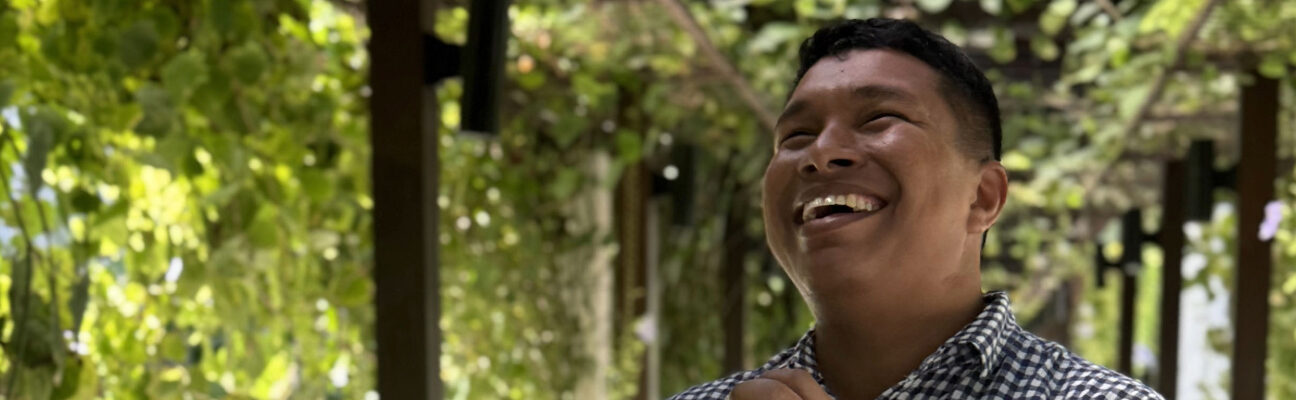
Turning the page: a new way to present leprosy on camera
At the end of 2024, we had an idea.
What if we handed over our digital channels to persons affected by leprosy for a whole month? What would they say? How would people react?
The takeover happened in September 2025 (search #OPLtakeover). We were really pleased with the campaign and assumed that would be the end of it, but the idea gained momentum. By January 2026, we had a World Leprosy Day campaign based on the same idea, which ILEP members (other leprosy NGOs) and the World Health Organization adopted.
There are a number of reasons why the concept captured so much attention. Perhaps the main reason was that persons affected by leprosy were given freedom to be their magnetic, personable, engaging selves. It was a new way to present leprosy on camera. And while the idea came from our team, the credit for its success goes to the people in front of camera who were so willing to be themselves – whether that meant sharing their joy or their sadness.
How did it work?
The International Leprosy Congress and Global Forum of Organisations of Persons Affected by Leprosy (OPLs), held in July 2025, brought many OPL leaders together. During these meetings, I captured informal videos, asking people to hold a microphone for a few moments while I asked some questions. We took the concept we had seen online of people being stopped in the street and interviewed, or people on a red carpet being asked to hold a lapel mic and answer rapid-fire questions.
We wanted this to be relaxed, so we asked the kinds of questions you would ask a friend. As a result, we got the kinds of answers your friend would give you. The kinds of answers that make you love your friends.
For the World Leprosy Day campaign, we worked with ILEP partners to capture similar videos with the help of in-country teams. We shared an example video and a guide to help them make the videos feel relaxed.
Three tips to recreate this dynamic
- Get your team on the same page.
From the beginning, we wanted this to be about storytelling. We had no agenda or message of our own. We wanted to hear what our interviewees had to say then present those stories as best we could.
This thread ran through the conceptualisation, the planning, the filming, the editing, and the eventual presentation of this online. We made sure everyone working on this project understood the concept and was committed to it. - Build trust and give freedom
Most of the people I interviewed I had met before. Of those I had not met, I benefited from introductions through friends who knew me well. This meant all of the interviews happened in an environment of trust. I also took the time to explain the concept to each interviewee, so they understood what we were aiming for.
Importantly, each person felt free to speak in a language they felt comfortable with. Help from translators and AI subtitling made that possible. - Get out of the way as much as you can
We tried to honour the word ‘takeover’ while understanding that our skills and experience as communications people were important to the idea’s execution. We wanted the stars of the show to be our interviewees. But we understood that good interview questions and engaging video editing would create the stage on which the stars could shine.
A hope for the future is that OPLs will have their own communications staff with the skillsets and platforms to regularly create this kind of content.
What could we have done better?
Greater engagement throughout the process
Initially, we developed this idea on our own, without bringing persons affected by leprosy on board. This is something we slightly corrected for the World Leprosy Day campaign, which the ILEP Panel of Persons Affected by Leprosy engaged with. If we did this again, I would see if any OPL representatives wanted to be involved throughout.
Sharing the results
Once the campaign was live, we did our best to share it through our OPL networks. But we did not have contact details for all of the contributors, so we could not send the results directly to them. This is something we corrected for the World Leprosy Day campaign.
What have we learnt?
There is a new way to present leprosy on camera: let people with lived experience be the communicators. Not the mouthpieces, but the storytellers. Here are three things that stood out.
Sharing skills was effective: There are many persons affected by leprosy who are powerful, inspiring, magnetic communicators. When they speak, you want to listen. It worked well when they shared these skills with us and we shared our skills for video editing and digital communication. It was a formidable partnership.
Modern approaches to video work: Leprosy might be an ancient disease, but that has not stopped us turning people with lived experience of the disease into TikTok-style stars. A lot of videos in our sector are serious and earnest. Creating space for fun allowed us to get to know the people we were hearing from, and it gave us more freedom to choose from different tones in our editing. Overall, this created a more powerful video series.
We all have a lot to learn from people with lived experience of leprosy: Have you ever felt lonely? Or had a tough time with your mental health? Ever been diagnosed with a chronic illness? Persons affected by leprosy have a lot to teach us about how to cope with and even thrive within these challenges. We tried to bring that out in the World Leprosy Day campaign and will continue to do so in the future.
Subscribe to our newsletter
Our weekly email newsletter, Network News, is an indispensable weekly digest of the latest updates on funding, jobs, resources, news and learning opportunities in the international development sector.
Subscribe nowRelated content
 Report
Narrative values: UK engagement with overseas “aid”
In the UK, there is still a strong moral instinct to support people facing poverty and crisis. But public engagement…

Politicians aren’t listening to the public on aid. They’re listening to the media.
New research suggests politicians are mistaking critical media coverage about ODA for public opinion. Correcting this misconception could be a gamechanger, argues Professor Martin Scott and Dr Paul Clist.

Your website as a governance asset: managing risk during change and scrutiny
Why it’s time to stop thinking about your organisation’s website solely as a communications tool.

Category
News & views