

Child poverty: what we know, what works, and what needs to change
The scale alone makes this one of the urgent challenges of our time. But there’s a harder question behind the numbers: are we making progress, and do we know what actually works?
A recent webinar by the Bond Child Rights group looked more deeply into these questions. This post summarises four key insights I shared in the presentation.
1. Child poverty is about rights, not just income
Multidimensional child poverty captures material deprivations that deny children their rights. Specifically, we are talking about unfulfilled rights that require directly material resources, such as housing, nutrition, healthcare, education, clean water and sanitation.
So poverty measurement needs to go beyond just capturing a lack of income or resources. While the lack of financial resources drives a lot of these deprivations, the overlap between multidimensional poverty and monetary poverty is not as close as it seems. Many children in better-off families still experience deprivations. For instance, in Indonesia, a 2017 study found more than 20% of children in the richest families were multidimensionally poor.
The poverty picture also varies enormously; obviously between countries, but also within them. Subnational data reveals that where a child is born, their gender and whether they live in a rural or urban area can matter as much as which country they are in. Climate risk further complicates this, and often works as a risk multiplier.
2. The burden is large, but progress is real
On the positive side, multidimensional child poverty fell from 63% in 2000 to roughly 40% in 2024 across low- and middle-income countries. That’s real progress. Hundreds of millions of children are now better off than they would have been two decades ago.
But the pace of change isn’t fast enough. Progress in reducing multidimensional child poverty has been slower than for other dimensions of poverty (or child mortality for that matter). It is also uneven, with middle-income countries often moving faster than low-income ones. This contradicts the idea that it should be easier to reduce child poverty where rates are highest. And it should focus our attention to systemic and structural barriers.
What is driving progress also differ between contexts. In some countries, education access has been the main contributor. In others, improvements in water and sanitation or health have done more of the heavy lifting.
3. We know what works
There’s more evidence on what reduces child poverty than most people assume. The 2025 flagship report by the Global Coalition to End Child Poverty drew on success stories from around the world, complemented by new academic research on the drivers of global poverty reduction. Four lessons come through clearly.
- Economic growth matters, but only if it reaches families in poverty.
In Bangladesh and Cambodia, for example, sustained growth aligned with better employment helped to lower monetary poverty. Indonesia combined growth in productive sectors with investments in social sectors and human capital to tackle both monetary and multidimensional poverty.
However, in countries such as Bangladesh, Senegal and Tanzania, rising inequality has offset some of the gains from growth. Had these countries reduced income inequality alongside growth, poverty reduction would have been significantly larger. - Inclusive social protection works.
Cash transfers, child benefits and safety nets help families cover basic needs and protect them from shocks. For example, in Peru the JUNTOS cash transfer programme improved children’s nutrition, education and cognitive outcomes. Tanzania’s Productive Social Safety Net and Senegal’s household security stipend wdere critical for tackling monetary poverty among households with children. In Poland, public spending on family benefits has driven one of the sharpest declines in child poverty among high-income countries. - Investments in social sectors are essential.
Addressing multidimensional child poverty requires sustained, public spending on health, education, social protection, housing, water and sanitation. Research by Amory Gethin found that education accounted for 40% of the reduction in extreme poverty since 1980, and about half of global economic growth. For instance, in Cambodia, expanding access to rural water and sanitation (alongside social protection programmes) has sharply reduced multidimensional child poverty.
But what matters is not only the quantity of public investments, but also its distribution. Evidence on pro-poor public spending shows that investments in health, education or social protection do not consistently benefit the poorest populations. - Tackling discrimination reduces barriers.
Legislation that addresses discrimination can expand access to social services and employment for marginalised groups. Girls, children from ethnic minorities and children with disabilities face compounding disadvantages which no single programme will fix without also addressing the structural barriers in their way.
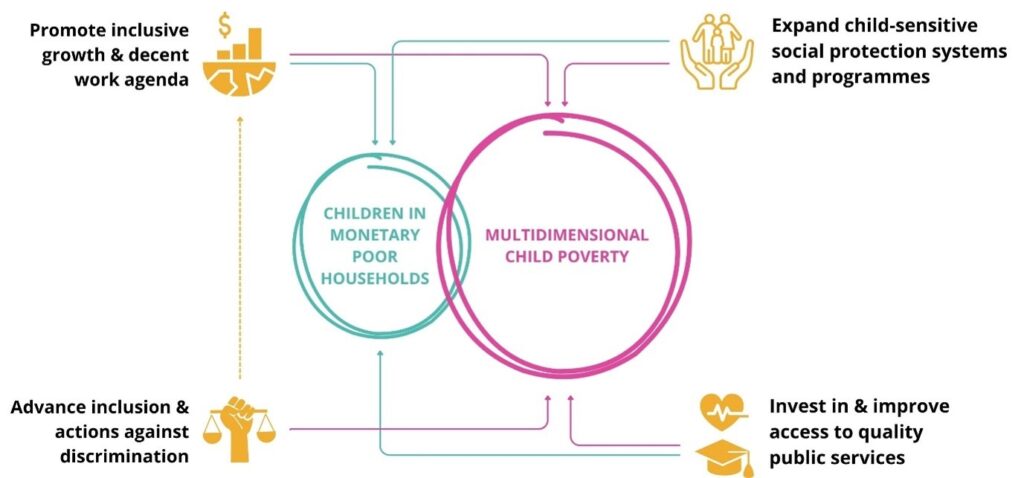
4. Why integration matters more than any single programme.
Progress in child poverty is closely linked to progress in other outcomes. This creates spillovers, and sometimes trade-offs, between sectors. It shouldn’t be a surprise that countries that have integrated policies and programmes to address interconnected issues like nutrition, health and sanitation have made particular progress in reducing child poverty
This is an area where more research is needed. While we often have good evidence on the effectiveness of more holistic interventions on individual outcomes (e.g., cash-plus models, early childhood development programmes, school feeding), we sometimes miss the larger spill-over effects these approaches can create.
Ending child poverty is a policy choice
The evidence shows that significant progress can be made when there is political will, investments in children and effective policies.
At times when ODA cuts, high debt levels and rising costs limit spending in many countries, child poverty offers a clear entry point. Addressing it through integrated approaches will tackle the structural root causes together, rather than in isolation.
Related content
More than a number, less than a priority
At least one humanitarian worker is killed, injured, kidnapped or detained every day. As we mark World Humanitarian Day it is time for the UK government to take meaningful action.

Differences matter: planning and delivering inclusive humanitarian action in contexts where explosive weapons are used
Explosive violence does not create inequalities – it exposes and intensifies them, yet a one-size-fits-all approach to civilians in war zones means many people are not being reached by humanitarian assistance.
Syria’s chance for a peaceful, inclusive future must not be wasted
In Syria, there is a deep desire for fairness and justice, where all ethnic and religious communities can live together in peace and dignity. The international community, including the UK, must ensure the transitional government realise this vision.

Category
News & viewsThemes
Humanitarian