
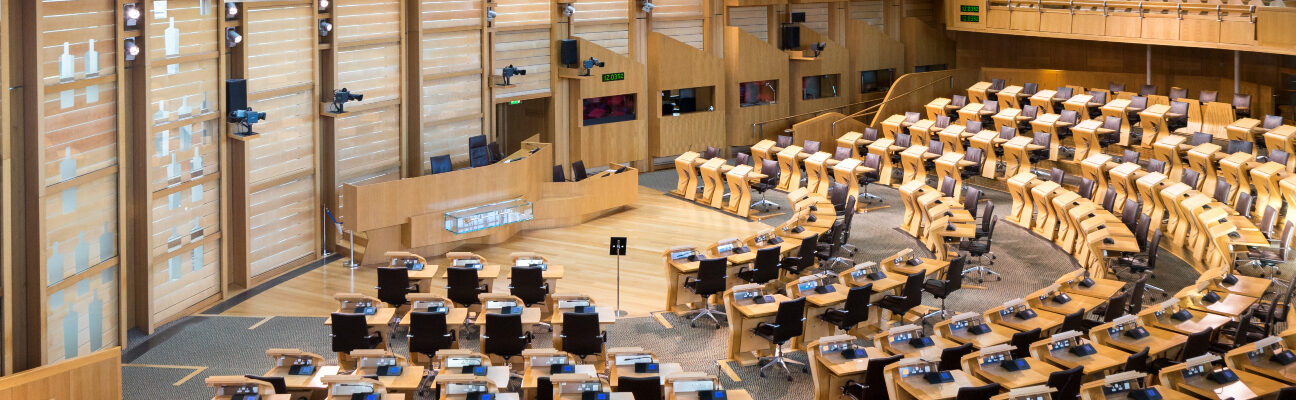
How will the new Scottish Parliament shape Scotland’s role in building a fairer world?
Throughout its 27-year history, the Scottish Parliament has looked outward, to learn from the wider world and to share its own experiences.
Working within the devolution settlement, successive governments have recognised that international solidarity is a key part of expressing the values inscribed on the Mace of Scotland’s Parliament: compassion, wisdom, justice and integrity.
The Scottish Government’s international development reach began in 2005, encouraged by the G8 Summit in Gleneagles, and marked by the establishment of an International Development Fund and a co-operation agreement with Malawi. It now includes a Climate Justice Fund, Humanitarian Emergency Fund and broader global partnerships, all of which have helped to save and improve lives in some of the world’s most fragile contexts.
Scotland’s civil society has been a central force throughout this journey. Organisations rooted in human rights, solidarity and justice have contributed to a vibrant international development community and helped Scotland build genuine credibility in this space. Scotland has conducted focused work with partner countries, carved out a distinctive role on climate justice and loss and damage, and made significant efforts to connect domestic policy choices with wider global responsibilities.
Post-election, where does Scotland’s Parliament stand on international development?
In the election’s aftermath, Scotland’s International Development Alliance (SIDA) and our members can take some heart from the fact that 100 of the 129 MSPs elected stood on manifestos that included commitments broadly supportive of continued Scottish engagement on international development and related global issues. We begin our engagement with the new parliament knowing there is significant support for the idea that Scotland should play its part in building a fairer world.
At the same time, this election confirms there is less cross-party consensus than there was in the past. As is the case across the UK, international development and climate justice can no longer be assumed to command broad support across Scotland’s political spectrum. This makes it all the more important for the sector to clearly and consistently make the case for our values and for action and encourage our supporters to do the same. This includes engaging with those parties and politicians who question the value of the Scottish Government’s international development policies.
Of the political parties now represented in parliament, the SNP made the clearest commitment to grow Scotland’s international development role. Its manifesto pledged to increase the £15 million International Development Fund by at least 25% by the end of the parliament, alongside the continuation and growth of the Climate Justice Fund and continued support through the Humanitarian Emergency Fund. It also proposed an aid match scheme and linked its wider international approach to human rights, climate justice, global debt and the Women, Peace and Security agenda.
The Scottish Greens, who will be an expanded force in the new parliament, also set out a strong outward-facing vision. Their manifesto framed Scotland as a force for peace, human rights and climate action, and included commitments to safeguard and expand Scotland’s international development programme.
Scottish Labour committed to maintaining the international development budget. Its manifesto also included support for an aid match scheme, for humanitarian aid to be delivered through not-for-profit organisations, and for stronger human rights due diligence in relation to public funding and business support.
The Scottish Liberal Democrats were less explicit about devolved development budgets, but their manifesto did include a broad commitment to human rights, climate action, fairness and international engagement.
By contrast, the Scottish Conservatives argued for reducing the Scottish Government’s foreign aid budget and ending the international climate change budget. Reform UK made no meaningful commitment on international development and coupled that absence with opposition to net zero spending and criticism of what it described as “lobbyist” charities.
Subscribe to our newsletter
Our weekly email newsletter, Network News, is an indispensable weekly digest of the latest updates on funding, jobs, resources, news and learning opportunities in the international development sector.
Subscribe nowContinued – yet contested – support for an outward looking Scotland
Taken together, the result is a parliament in which support for Scotland’s outward-looking role remains real, but more contested than before. Some parties are openly sceptical of elements that once attracted wider agreement. Yet there is also encouragement in the fact that several manifestos echo important parts of SIDA’s policy priorities.
The SNP will again lead the Scottish Government but without an overall majority. It will need to work with other parties on a case-by-case basis. This creates both uncertainty and opportunity. It means the direction of travel cannot be taken for granted, but it also means there is scope to build support across parliament for practical measures that reflect shared values and deliver meaningful impact.
We expect the new government to launch an overall review of international development policy and funding priorities. When that happens, we will work to ensure the review reflects the key asks set out in SIDA’s Policy Priorities 2026 to 2031. This includes protecting and growing Scotland’s financing for development, scaling up climate action at home and abroad, empowering women and advancing gender equality, showing leadership on global debt, finance and tax justice, and strengthening global citizenship, diaspora inclusion and civil society accountability. Across all of this, we will continue to make the case for a deeper shift in power and decision making towards people and communities in the Majority World.
We also await confirmation of how this policy area will be reflected in ministerial portfolios. There was previously a dedicated Minister for International Development, but in recent years responsibility has been folded into a broader Cabinet Secretary brief covering external affairs. These structures matter – ministerial focus, accountability and visibility all affect whether commitments translate into funded programmes and long-term policy direction.
The election, and the result, provides a moment for reflection and for renewed engagement. We will continue to work with the new parliament and government, and with parties across the chamber, to help ensure that Scotland’s contribution remains bold, coherent and rooted in justice.

Category
News & viewsThemes
Politics