
How we took our Global Safeguarding Focal Point training online without losing impact
Like many humanitarian organisations, Mercy Corps has been adapting to a changing funding landscape.
This has resulted in us delivering our first, fully remote Safeguarding Focal Point training for countries across Africa, Asia, Europe and the Middle East.
Rather than treat remote delivery as a compromise, we set out to design a training that was highly participatory, practical and responsive to participants’ needs and working realities. Here’s what we did, and what we learned.
Designing the training with participants
We conducted a pre-training survey to better understand what would work best for participants given their existing workloads to maximize participation. We asked about their preferred session length, number of sessions per week and overall programme duration.
Through our collaborative design process, we landed on a four-week programme with 12 core sessions over four weeks. Each session was two hours, three times a week and we arranged a fourth week specifically for safeguarding officers and managers. This ensured participants had a tailored schedule that fit their needs, and it helped to address some of our main concerns: participant drop-off and remote-learning fatigue.
Reworking content for impact, not volume
Our next task involved adapting five full days’ worth of in-person training material to remote learning. Each module needed to be limited to two hours, factoring in a break and some cushion for potential IT issues.
We had developed an expansive and robust set of materials over the years, so reducing it so dramatically was challenging. Our team reviewed all existing training material, and made some difficult but intentional decisions. This process was time intensive, and took us almost two months to complete while juggling our day-to-day work. Initially, everything felt essential, but we managed to condense our material significantly by focusing on key learning outcomes. We prioritised depth of understanding over breadth. Any duplication or material that did not directly address the refined learning outcomes was removed.
Making virtual learning engaging
Once our material fit our time constraints (after several dry runs) we began adapting exercises to interactive online formats. We wanted to build in breaks from PowerPoint presentations and enable participants to grapple with safeguarding principles through meaningful discussions.
To do this, we knew we had to maximise what Microsoft Teams could offer, including:
- online whiteboards for individual and group work
- templates with sticky notes for visual mapping (to mirror physical exercises)
- polls to check understanding and prompt reflection
- word maps and brainstorms
- frequent breakout groups for discussion and applied learning.
These tools, alongside frequent check-ins, helped us recreate the collaborative spirit of in-person training while making space for quieter reflection and smaller group discussions. We also assigned two facilitators each day, rotating between three of us to avoid burnout.
Adapting complex content for a remote environment
Our policy session was one of the lengthiest to adapt as it’s where we cover all our safeguarding policies through a variety of exercises and group discussions. Condensing this required careful prioritisation as we risked turning it into a two-hour, one-way presentation. We did this by focusing on each policy’s key elements, then running a whiteboard, scenario-based exercise to check participants’ learning.
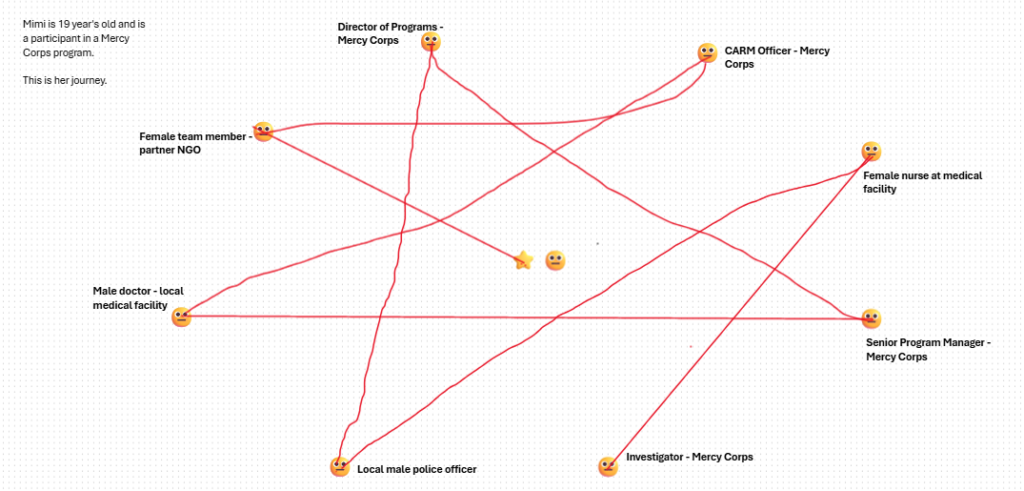
A particular highlight was our reimagining of the Survivor Web exercise. In-person, this impactful exercise is delivered using a ball of yarn to demonstrate the complex web of interactions a survivor may experience when reporting harm. For the virtual training, we used a whiteboard and set up the following:
- we put one emoji in the middle to represent the survivor, and other emojis around it in a circle to represent the people a survivor may interact with
- we asked one participant to visually map interactions between a survivor, community members, staff, and others as the case study was read aloud
- we asked the participant to draw lines to represent each interaction with the survivor
The resulting visual successfully recreated the impact of the tangled web, illustrating how survivors are often required to repeatedly retell their experiences as a consequence of poor processes and unprepared team members. This emotional and powerful exercise resonated deeply with our online participants, raising a variety of questions and highlighting the importance of a survivor-centred approach. The participants described how it “gave us an opportunity to reflect deeply about power dynamics and the values we need to uphold”. In the end, nothing was lost by delivering this in an online space, rather than in-person.
An enriched training experience
The first remote edition of this training has been one of our most enriching, engaging and impactful yet, and it has opened the door to a cross-regional Community of Practice.
Building on this momentum, we look forward to running further remote Global Safeguarding Focal Point training sessions. This experience reaffirmed that when training is participant-centred and grounded in operational realities, it can be impactful, even across screens.

Category
News & viewsThemes
Safeguarding