
Crossing language barriers to open up worlds
Austro-British philosopher Ludwig Wittgenstein wrote:
The limits of my language mean the limits of my world.
In many parts of the Western world, deaf communities are often tight-knit, united by shared sign language and lived experience. In Rwanda, as in many under-resourced countries, deaf people are often left isolated, unable to communicate beyond their immediate family.
Schools are often full, yet they lack the resources, technology and sometimes even electricity to support different learning needs. As a result, many deaf people in Rwanda never get the opportunity to learn their country’s sign language and struggle within systems not designed to accommodate them.
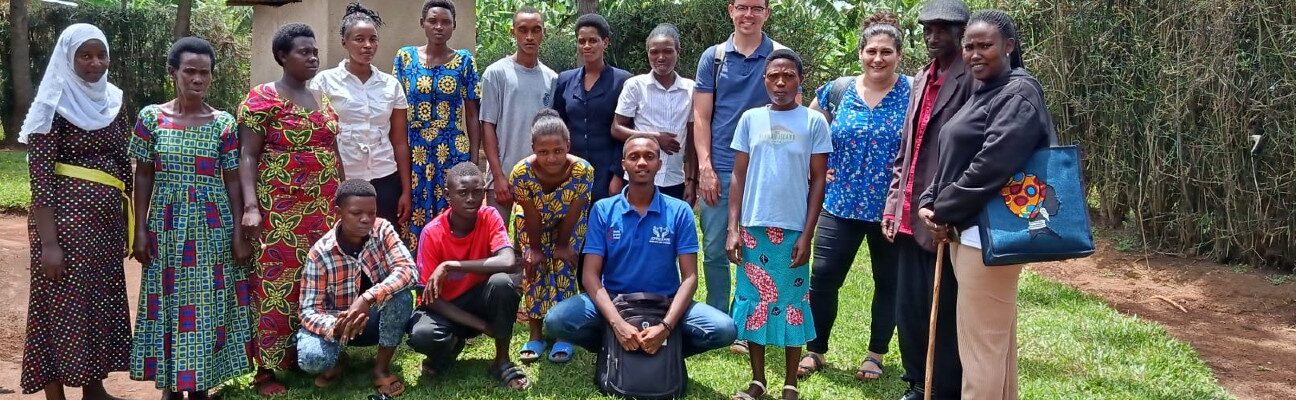
World Jewish Relief encountered this reality during recruitment for people with disabilities for our livelihoods-focused agricultural project in Rwanda’s Eastern Province. Our local partner, Farm Master Services, identified 12 individuals with profound hearing impairment. Most were unemployed or working as day labourers earning around 80 pence a day. We began planning how to include them in farm cooperative groups but quickly encountered an unexpected challenge.
While participants could communicate within their own families, they did not share a common language with one another. Each relied on self-developed signs, making communication outside their households extremely limited. Without a shared language, working together in a cooperative was not possible.
This discovery was both shocking and motivating, revealing that their isolation ran far deeper than we had understood.
Solution one: Rwandan Sign Language
Initially, we thought the solution was simple: Rwanda has its own sign language – why not teach it?
After some searching, we found our teacher in Rebecca, who had attended Rwanda’s only school for deaf and hearing impaired students. She knew Rwandan Sign Language, could read lips and spoke Kinyarwanda. She became the bridge between participants and our programme.
We set up a 12-week course offering weekly, two-hour lessons to begin building a shared language.
That’s when the next challenge emerged.
We assumed we could use existing local materials, as government sources indicated that banners and posters were available. But these proved limited: themes were random, and many showed vocabulary without demonstrating the signs, rendering them largely useless.
We turned online, digging up any Rwandan sign language resources we could find. While some provided signs and meanings with clear illustrations, they only offered limited vocabulary: greetings, question words, a disparate array of verbs and signs for family members.
This was far from sufficient for everyday communication – we needed something more comprehensive.
Breakthroughs and set-backs
Further research led us to a one-volume Rwandan Sign Language dictionary published in 2009. However, it was not digitised and no copies were accessible. One name repeatedly appeared in connection with it.
As a last-ditch effort, I contacted this person through her personal website, explaining our work and asking if she might still have a copy. To my surprise, she responded quickly and generously offered to digitise the entire dictionary for us.
This transformed the programme. We built a structured curriculum organised around practical themes, such as food, emotions, places and everyday objects. Lessons became more systematic, with time for practice, review and vocabulary-building.
But another challenge soon surfaced.
Most participants were functionally illiterate, having dropped out of schools unequipped to support them. They could not read the written definitions accompanying the signs. Despite the effort invested, the materials were not accessible.
So we adapted again.
If written definitions wouldn’t work, we needed a fully visual approach. Using AI-generated and carefully selected images, we created a visual dictionary conveying the meaning of over 250 signs.
When classes resumed, the difference was immediate.
By the end of the 12-week course, participants achieved an average of over 70% accuracy in assessments based on random samples of signs. More importantly, they now shared a foundation in Rwandan Sign Language. Communication expanded beyond families, enabling connection with one another and with the wider deaf community.
Opportunities and belonging: the power of a shared language
For World Jewish Relief and Farm Master Services, this shared language unlocked the next step.
Participants can now engage in specialised agricultural training designed with sign and visual instruction. Previously inaccessible, this training now allows them to follow instruction, participate in group learning, and begin building the livelihoods that may transform their futures.
Just as importantly, they have begun forming a community – meeting peers, spending time together and experiencing something many had not known before: a sense of belonging, built through a common language.
The next step is to provide mental health support alongside agricultural training. Growing up with such isolation can have lasting effects, and we want participants to have the tools to navigate this. This includes a language refresher course to support engagement in therapy and strengthen relationships.
None of this has been straightforward. As with much development work, especially when reaching those most often excluded, there are always obstacles. Some can be anticipated, others cannot. But inclusion is not pursued because it is easy; it is pursued because it is right.

Category
News & viewsThemes
Disability and Inclusion