
Civic space, democracy and human rights in 2025
For several years now, global indices monitoring human rights and democracy have shown that civic space is under pressure and that authoritarianism and populism are on the rise.
However, it feels like these trends accelerated in 2025. Catastrophic cuts to official development assistance (ODA) and USAID, the growth of the anti-rights movement, attacks on migrants and refugees and the curtailing of protest rights have profoundly impacted civil society in the UK and globally.
Civic space under pressure in the U.S.
President Trump returned to the White House in January 2025. In the first three months of his second term, the International Institute for Democracy and Electoral Assistance issued 20 alerts on democracy in the US, twice as many as it had issued in the whole of the previous two years. Each alert documented an instance where the U.S. government “eroded and abolished the rules, institutions and norms that have shaped U.S. democracy.” Examples include efforts to restrict academic freedom, criminalise protest activity, restrict media access and circumvent due process.
In July, CIVICUS, the global civic space monitoring group, added the US to its watchlist, citing “clear signs of democratic backsliding”. It expressed concern about a crackdown on peaceful assemblies, deployment of the national guard and the targeting of journalists for covering protests. The administration has also publicly attacked progressive grant making foundations and has introduced tax legislation that will reduce funding for many civil society organisations.
Support for democracy and human rights in decline
The decision to close USAID and cut spending on Official Development Assistance has had profound implications for civil society globally. The U.S. was one of the largest funders of democracy support and human rights work around the world and it provided direct support to many independent media outlets and human rights defenders (HRDs).
The US was the primary donor to Lifeline, an emergency assistance programme for activists at risk, which was forced to close its doors earlier this year. Despite making significant cuts to its own ODA spending, the UK is working with other donors to revive this vital programme.
The UK is also due to release updated guidance for HRDs that will make it easier for them to understand and access the support available from British missions. The guidance should set strong standards for diplomats, provide them with practical advice, and clarify how Whitehall will support them to monitor and improve support for HRDs.
In June 2025, the OECD DAC published a toolkit to supplement its own guidance for states on how they can best support civil society, including HRDs. The Toolkit for Implementing the DAC Recommendation on Enabling Civil Society in Development Cooperation and Humanitarian Assistance, offers practical guidance to bilateral donors on how to protect and promote civic space in partner countries.
While strengthened guidance is welcome, its impact is likely to be undermined by funding cuts. Civil society, HRDs, and independent media all play an important role in strengthening democratic resilience and accountability, and when their support is withdrawn, the risk of authoritarianism increases.
Global anti-rights movement goes from strength to strength
The reach and influence of the global anti-rights movement continues to grow. Anti-rights groups are becoming increasingly well organised, funded and politically connected. They target the rights of women and minoritised and racialised groups using a range of tactics including spreading false and misleading information, promoting harmful and divisive narratives, and using strategic lobbying to exert undue influence.
Feminist activists have documented how U.S. anti-rights groups are seeking to establish a foothold in Africa through founding television and radio channels, organising high profile conferences, offering educational scholarships, setting up pregnancy crisis centres and influencing law makers.
While it may seem like they are trying to take societies back to a previous era, according to Partos, anti-rights groups are actually “trying to take us into a new future where inequality and hierarchy between racial groups, genders, and sexual orientations are normalised as the basis of society”.
The UK is not immune. Research published by Amnesty International UK shows the UK is home to “a rapidly expanding network of organisations working to undermine human rights protections, targeting reproductive freedoms, LGBTI rights and promoting dangerous practices such as so-called ‘conversion therapy’.”
Migrants and refugees targeted
Attacks have also increased on migrants and groups that provide support and advocate for their rights. In the US, the tactics of Immigration and Customs Enforcement (ICE) patrols, which include raids on undocumented migrants, have prompted widespread criticism and protests.
In the UK, several anti-refugee and migrant demonstrations took place over the summer. In September, 150,000 people attended a protest march in London, which was organised and addressed by prominent far right activists. Over 200 charity CEOs signed a letter condemning the protests, which they described as “distressing to witness, with echoes of last summer’s riots making them all the more alarming.”
Attacks on charities that support refugees and migrants are also on the rise. In October, 150 charity leaders called on government ministers to take steps to address the rise in violence targeted at these organisations, their staff, volunteers and trustees. Many organisations have been forced to implement security measures to protect their staff, and the Charity Commission has removed the names of trustees of refugee charities from its register to keep them safe.
Protest rights curtailed
Pressure continues to grow on protest rights in the UK and elsewhere around the world. There was some positive news from the UK this year. In May, Liberty won their legal challenge against government plans to lower the threshold for what constitutes “serious disruption”. In July, the Government published the Civil Society Covenant, an agreement between civil society and the government that aims to improve relations, which included a clear promise to protect the right to peaceful protest.
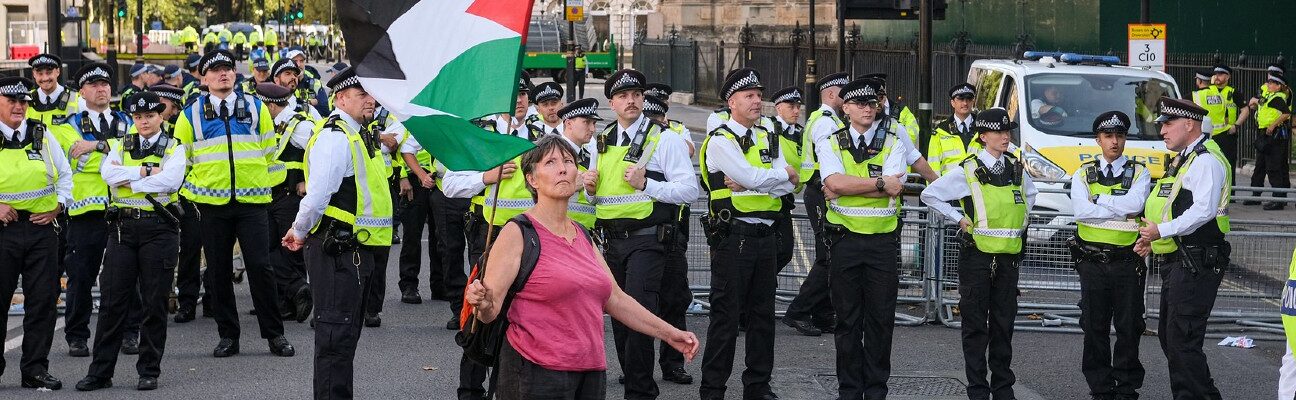
However, the government also announced plans to proscribe Palestine Action under the Terrorism Act 2000, the first time a protest group has been banned in this way. Since the MPs voted to ban the group in early July, more than 2,100 people have been arrested on terrorism charges for protesting in support of the proscribed group, and more protests are planned.
The government continues to push for yet more anti-protest powers, introducing the Crime and Policing Bill in February and then adding further measures to the draft legislation in September. The bill will give the police powers to ban the wearing of face coverings at protests, impose conditions on protests that prevent them from passing near places of worship, and enable police to consider the “cumulative impact” of protests.
Standing in solidarity
At a time when funding cuts are having a profound impact on the international development community it’s tempting for organisations to focus in on their core priorities. But now is the time for civil society organisations from different sectors to come together and act in solidarity with those most impacted: communities facing racism, antisemitism, and islamophobia; migrants, refugees and the charities that support them who are facing violent threats from the far right; and peaceful protesters who have had their rights curtailed.
While it may seem daunting, there are practical things that individuals and organisations can do. Reading more about the actions you can take in solidarity and the need for the international development sector to live its anti-racism values are good places to start, as is watching our webinar on civic space in the UK.

Category
News & viewsThemes
Civic space